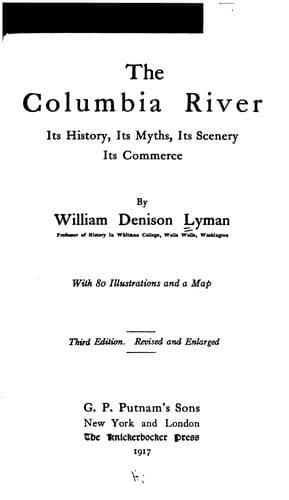
The Columbia River: Its History, Its Myths, Its Scenery, Its CommerceLyman, William Denison
History
The Columbia River: Its History, Its Myths, Its Scenery, Its Commerce
Lyman, William Denison
Columbia River; Columbia River -- Description and travel; Columbia River -- History
In 1819 another very important step was taken; viz.: the Florida Treaty
with Spain. By this, Spain retired to the line of 42 degrees, ceding to
the American Republic all her rights above that line. With her own claims
joined to those of Spain, the Republic would seem to be able to snap her
fingers at England. But, with characteristic tenacity, the latter power
made ready to insist all the more strenuously upon her claims. In 1825
England and the United States agreed with Russia upon the line of 54
degrees 40 minutes, as the southern line of Russian claims. With Spain and
Russia out of it, Oregon was left for England and the United States to
fight over. The Joint Occupation Treaty was to last ten years, with the
privilege of renewal. Meanwhile what were the factors in the struggle for
possession? There was on the side of England the Briarean monopoly of the
Hudson's Bay Company, supported by a disciplined and intelligent
government. But the English people were not in it. On the American side
the Government was strangely indifferent. There were several ambitious
attempts to control the situation by American trading and fur companies.
But the essential forces were the American immigrant, the American
missionary, the Declaration of Independence, and the ox-team. Those were
the champions of America. They were the Davids against the Goliaths of
British monopoly. At first thought it seemed that Goliath would have a
"walk-over." The case seemed hopeless for the Americans.
But to the deeper observer, American triumph was inevitable. It was the
Age of Democracy. The conception both of popular government and of
individual ownership of land, with which went the corollary of "equal
opportunities for all men and special privileges for none," was graven
deep upon American character. With these things there went, of necessity,
the disapproval of slavery and the support of free labour. Still further
there went, by the same logic, the doctrine of unity and continental
expansion. These various influences have constituted the broad foundation
on which were reared the towers and battlements of American nationality.
In previous chapters we have outlined the operations of the Hudson's Bay
Company, the coming of the missionaries, and the immigrations of
Americans. The policy of the Hudson's Bay Company was to keep the country
a wilderness, to maintain amicable relations with the Indians, and to
depend mainly on the fur-trade for the great profits of their enterprise.
The policy of the American immigrants was to build homes, cities, roads,
steamboats, mills, develop the country, crowd out the natives, and depend
on mining, farming, stock-raising, lumbering, for their profits; not
profits of a monopoly located in a distant money centre, but profits of
the individual worker on his own land. The difference was world-wide. It
represented two different conceptions of government and of life itself.
Public-domain text, read in full here on John Shaqi.
Reviews
Reviews
No reviews yet
Be the first to share your thoughts on this work.
Elsewhere in the archive
Join the Discussion
Join the discussion
Sign in to leave a comment or review.
Sign InorCreate an account