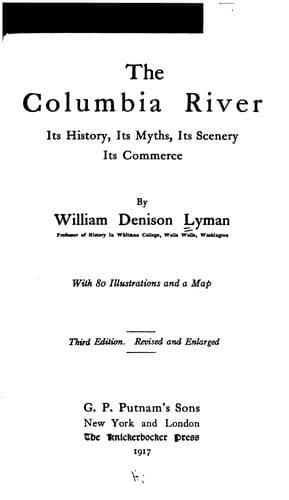
The Columbia River: Its History, Its Myths, Its Scenery, Its CommerceLyman, William Denison
History
The Columbia River: Its History, Its Myths, Its Scenery, Its Commerce
Lyman, William Denison
Columbia River; Columbia River -- Description and travel; Columbia River -- History
Such an estimate by American statesmen was all right to the Hudson's Bay
Company. They wished such an estimate and had taken pains to foster it.
But while the gullible American statesmen were thus accepting just the
version which their rivals were disseminating, the hard-handed and
hard-headed, though not hard-hearted frontiersmen of Missouri and Illinois
and Iowa were packing their ox-teams and starting across the desert for
that Sahara on the Columbia River. Also one Marcus Whitman, a missionary
physician of the Walla Walla, was floundering in the snows of the Sierra
Madre and crossing the Arkansas through broken ice, in order to tell the
benighted statesmen what the land of the Oregon really was like. The
American people were busy, and the statesmen looked askance. And so, a few
here and a few there, by trail or ship, adventurers, missionaries,
sailors, trappers, there was formed a gathering in the Willamette of the
advance guard of American home-builders. They began to call out of the
wilderness to Uncle Sam.
As a result of the coming of the missionaries and of the small
immigrations of the thirties and early forties, together with the
settlement in the Willamette Valley of various French-Canadian employees
of the Hudson's Bay Company, there was enough of a population to demand
some sort of organised society.
W. H. Gray made a summary of population in 1840 to consist of two hundred
persons, of whom a hundred and thirty-seven were American and sixty-three
Canadian. Up to 1839 the only law was the rules of the Hudson's Bay
Company. In that year the Methodist missionaries suggested that two
persons be named as magistrates to administer justice according to the
ordinary rules of American law. This was the first move looking to
American political organisation. In 1839 and 1840 memorials were presented
to the Senate by Senator Linn of Missouri at the request of American
settlers praying for the attention of Congress to their needs. But, not
content with lifting their voices to the home land, they proceeded to
organise for themselves.
At that time, Champoeg, a few miles above the falls of the Willamette and
located pleasantly on the west bank of that river, was the chief
settlement. There, on the seventh of February, 1841, a gathering of the
settlers was held "for the purpose of consulting upon steps necessary to
be taken for the formation of laws, and the election of officers to
execute them." Jason Lee, the Methodist missionary, was chairman of the
meeting, and he outlined what he deemed the needed method of establishing
a reign of law and order. The meeting proved rather a conference than an
organisation and the people dispersed to meet again at the call of the
chairman.
Public-domain text, read in full here on John Shaqi.
Reviews
Reviews
No reviews yet
Be the first to share your thoughts on this work.
Elsewhere in the archive
Join the Discussion
Join the discussion
Sign in to leave a comment or review.
Sign InorCreate an account