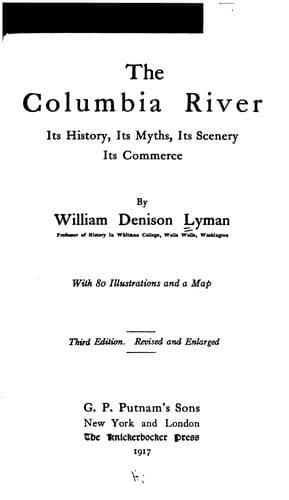
The Columbia River: Its History, Its Myths, Its Scenery, Its CommerceLyman, William Denison
History
The Columbia River: Its History, Its Myths, Its Scenery, Its Commerce
Lyman, William Denison
Columbia River; Columbia River -- Description and travel; Columbia River -- History
But though the American people had the manifest destiny of expanding to
the Pacific, the Government was strangely supine. We say "strangely," but
it was not so strange after all. Congress was dominated by the South in
the interest of slavery, and by the East in the interest of the tariff.
Calhoun usually led the South, and he weighed everything in the scales of
slavery. Webster governed Eastern sentiment largely, and he spoke for New
England manufacturers. It is true that Clay was at all times a power in
the councils of the nation, and Clay's constant word was nationalisation
and expansion. But even Clay was so committed to the tariff that he did
not always appreciate the possibilities of the "West-most West." The
Presidents of the period from 1819 to 1846 were from the South or the
Atlantic seaboard and not usually inclined to regard the far West with
special interest.
The American people were away ahead of the American government in the
struggle for possession of Oregon. A few of the utterances of leading
statesmen of that period as significant of their conception of Oregon,
may be given here. Benton, who became later the greatest champion of
Oregon, was so imperfectly informed in 1825 that he spoke thus: "The ridge
of the Rocky Mountains may be named as a convenient, natural, and
everlasting boundary. Along this ridge the western limit of the Republic
should be drawn, and the statue of the fabled god Terminus should be
erected on its highest peak, never to be thrown down." But Benton
improved, for later referring to the Columbia, he said, "That way lies the
Orient." Webster said of Oregon: "What do we want of this vast, worthless
area, this region of savages and wild beasts, of shifting sands and
whirlwinds of dust, of cactus and prairie dogs. To what use could we ever
hope to put these great deserts or these great mountain ranges,
impenetrable and covered to their base with eternal snow? What can we ever
hope to do with the western coast, a coast of three thousand miles,
rock-bound, cheerless, and uninviting, and not a harbour on it? What use
have we of such a country? Mr. President, I will never vote one cent from
the public treasury to place the Pacific Coast one inch nearer Boston than
it is now." And that was "God-like Dan!" Dayton expressed himself thus:
"God forbid that the time should ever come when a State on the shores of
the Pacific, with interests and tendencies of trade all looking toward the
Asiatic nations of the East, shall add its jarring claims to our
distracted and already overburdened confederacy." The _National
Intelligencer_ doubtless expressed a common sentiment in the following:
"Of all the countries upon the face of the earth, Oregon is one of the
least favoured by nature. It is almost as barren as Sahara and quite as
unhealthy as the campagna of Italy."
Public-domain text, read in full here on John Shaqi.
Reviews
Reviews
No reviews yet
Be the first to share your thoughts on this work.
Elsewhere in the archive
Join the Discussion
Join the discussion
Sign in to leave a comment or review.
Sign InorCreate an account