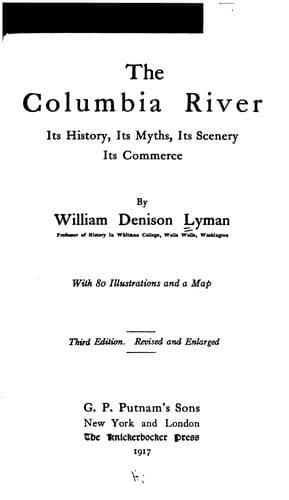
The Columbia River: Its History, Its Myths, Its Scenery, Its CommerceLyman, William Denison
History
The Columbia River: Its History, Its Myths, Its Scenery, Its Commerce
Lyman, William Denison
Columbia River; Columbia River -- Description and travel; Columbia River -- History
Another most significant fact was the attitude of the Hudson's Bay
Company. That great organisation was of course opposed to American
ownership and to the Provisional Government. At first, the management
under Sir James Douglas (Dr. McLoughlin had been superseded by Douglas
because of his supposed leaning toward the Americans) affected to ignore
the government framed at Champoeg, declaring loftily that the company
could protect itself. Dr. McLoughlin, in his very interesting account of
this, says that the Americans adopted in 1845 a provision in the
constitution that no one should be called to do any act contrary to his
allegiance. This provision struck him as designed to enable British
subjects to join the organisation. Dr. McLoughlin was so pleased with the
wise and liberal spirit which this evinced that he prevailed on Douglas to
join the Provisional Government. The family was now complete. The American
farmers and immigrants and missionaries had triumphed over the autocratic
government of the great fur company. The American idea--government of the
people, by the people, and for the people--was vindicated. The local
battle was won for the Yankee.
Before leaving this great epoch of the history of the River, it will
interest the reader to know that Dr. McLoughlin, so conspicuous in the
story thus far, removed to Oregon City, and became an avowed American
citizen, living on the claim on which he filed at the Falls. Much trouble
subsequently arose between him and the Methodist mission people
represented by Rev. A. F. Waller. Harder yet, Congress was led by Delegate
Thurston of Oregon, to exclude him from the benefit of the Donation Land
Law. The final result was that the great-hearted ex-king of the Columbia
lost the most of his claim on the ground that he was an alien at the time
of taking it. The Hudson's Bay Company directors chose to disapprove his
acts in bestowing provisions upon the weary and hungry and ragged American
immigrants, and they charged him personally with the cost. This, in
addition to the loss of his claim, rendered him almost penniless and sadly
embittered his old age. He said that he supposed he was becoming an
American, but found that he was neither American nor British, but was
without a country. It is pleasant to be able to record the fact that the
Oregon Legislature restored his land in so far as the State controlled it,
but this was only just before his death.
Public-domain text, read in full here on John Shaqi.
Reviews
Reviews
No reviews yet
Be the first to share your thoughts on this work.
Elsewhere in the archive
Join the Discussion
Join the discussion
Sign in to leave a comment or review.
Sign InorCreate an account