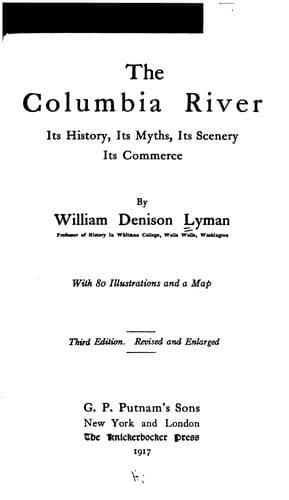
The Columbia River: Its History, Its Myths, Its Scenery, Its CommerceLyman, William Denison
History
The Columbia River: Its History, Its Myths, Its Scenery, Its Commerce
Lyman, William Denison
Columbia River; Columbia River -- Description and travel; Columbia River -- History
The officers of government consisted of a legislative body of nine
persons, an executive body of three, and a judiciary of a supreme judge
and two justices of the peace, with a probate court and its justices, and
a recorder and treasurer. Every white man of twenty-one years or more
could vote. The laws of Iowa were designated to be followed in common
practice. Marriage was allowed to males at sixteen and females at
fourteen. One of the most important provisions was the land law. This
permitted any individual to claim a mile square, provided it be not on a
town site or water-power, and that any mission claims already made be not
affected, up to the limit of six miles square. This land law was framed
upon the general conception of the proposed Linn bill already brought
before Congress. The land law allowed land to be taken in any form, but
since there was no existing survey, each man had to make his own survey.
The first elected executive committee consisted of David Hill, Alanson
Beers, and Joseph Gale. Within a year an amendment was made to the
constitution providing for a governor. George Abernethy, a former member
of the Methodist mission, was chosen to fill the place.
Outer things were pretty crude in the little colony on the Willamette,
though brains and energy were there in abundance. J. Quinn Thornton
expressed himself as follows on the "Oregon State House," which he says
was in several respects different from that in which laws are made at
Washington City:
The Oregon State House was built with posts set upright, one end set
in the ground, grooved on two sides, and filled in with poles and
split timber, such as would be suitable for fence rails, with plates
and poles across the top. Rafters and horizontal poles, instead of
iron ribs, held the cedar bark which was used instead of thick copper
for roofing. It was twenty by forty feet and therefore did not cover
three acres and a half. At one end some puncheons were put up for a
platform for the president; some poles and slabs were placed around
for seats; three planks, about a foot wide and twelve feet long,
placed upon a sort of stake platform for a table, were all that was
believed necessary for the use of the legislative committee and the
clerks.
There are several facts in connection with the inauguration of this
Provisional Government of Oregon which are almost equal to itself in
interest. One of these is that Peter H. Burnett, a lawyer and the most
notable member of the emigration of 1843, rendered the opinion that, by
the spirit of American institutions, the Provisional Government might be
regarded as possessing valid authority. Going in a few years to
California, Mr. Burnett incorporated the same principles into the
government of that State and became its first governor.
Public-domain text, read in full here on John Shaqi.
Reviews
Reviews
No reviews yet
Be the first to share your thoughts on this work.
Elsewhere in the archive
Join the Discussion
Join the discussion
Sign in to leave a comment or review.
Sign InorCreate an account