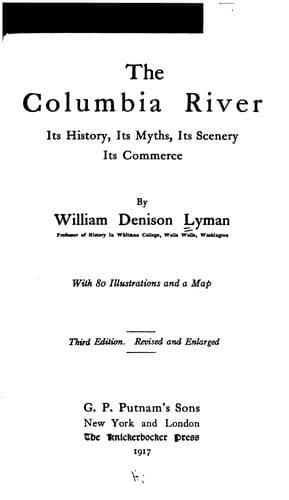
The Columbia River: Its History, Its Myths, Its Scenery, Its CommerceLyman, William Denison
History
The Columbia River: Its History, Its Myths, Its Scenery, Its Commerce
Lyman, William Denison
Columbia River; Columbia River -- Description and travel; Columbia River -- History
But a curious and anomalistic alignment of interests and parties now
arose. The Oregon question became entangled with those of Texas and
slavery. Calhoun became Tyler's Secretary of State upon Webster's
resignation. While the Democrats in general were more inclined to western
expansion than the Whigs, yet the slaveholders of the South were much more
interested in Texas than in Oregon. The Provisional Government of Oregon
had prohibited slavery. Calhoun was ready to fight Mexico for the
possession of Texas, but he did not want to fight England for possession
of Oregon. Nevertheless, he did not dare to offend the West by a square
back-down on Oregon. He therefore adopted a policy of "masterly
inactivity." He believed that if war arose with England, we would lose
"every inch of Oregon," for England could hurry a fleet to the Columbia
River from China in six weeks, whereas American ships would have to double
Cape Horn, and an American army would have to cross the continent under
every disadvantage of transportation. But time, he believed, would win all
for the Americans.
In this conception, Von Holst thinks Calhoun was wise. Roosevelt in his
_Life of Benton_, thinks that the war, if there had been war, would have
been fought out in Canada, and that, while Calhoun was not wrong in
desiring delay, he should never have abated one jot in demanding all of
Oregon up to 54 degrees 40 minutes.
The Democratic platform on which Polk was elected President, demanded "54
degrees 40 minutes," and, in popular clamour, the words, "or fight," were
added. Oregon, Texas, and slavery were practically the issues on which
Polk was elected. His inaugural address declared our title to Oregon to be
"clear and unquestionable." Great excitement ensued, for if Congress stood
by the President, war was almost inevitable, unless England yielded. To
the surprise of the world, however, James Buchanan, the yielding, not to
say shifty, Secretary of State under the new administration, now announced
the willingness of our Government to compromise on the line of 49 degrees.
But here another complication ensued. Pakenham, the British envoy,
declined, in almost insulting terms, to accept 49 degrees. Polk thereupon
withdrew the proposition and in his next message stated that "no
compromise which the United States ought to accept can be effected." At
the same time he advised the cancellation of the Joint Occupation Treaty.
It seemed now that the conflict between the nations for the possession of
the River would surely eventuate in war. Senator Cass of Michigan fanned
the flame by a speech declaring that "War is almost upon us." The
committees on Foreign Relations in both House and Senate proposed
resolutions to notify England at once of the close of the Joint Occupation
Treaty. Excitement rose to fierce heat, and the standing of marine risks
and commercial ventures at once showed the popular sentiment. "Fifty-four,
forty, or fight!" was the spirit of Congress.
Public-domain text, read in full here on John Shaqi.
Reviews
Reviews
No reviews yet
Be the first to share your thoughts on this work.
Elsewhere in the archive
Join the Discussion
Join the discussion
Sign in to leave a comment or review.
Sign InorCreate an account