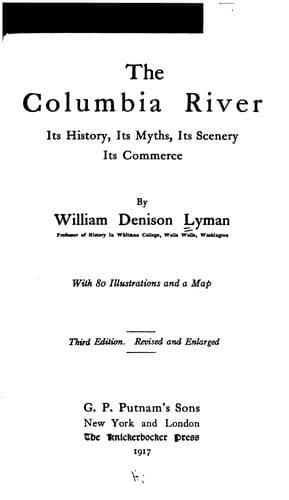
The Columbia River: Its History, Its Myths, Its Scenery, Its CommerceLyman, William Denison
History
The Columbia River: Its History, Its Myths, Its Scenery, Its Commerce
Lyman, William Denison
Columbia River; Columbia River -- Description and travel; Columbia River -- History
But now Calhoun found himself betwixt the devil and the deep sea. He did
not really wish to get all of Oregon, for fear of the effect on slavery.
Yet he dared not throw cold water on the tremendous spirits of patriotism
and ambition in the West demanding Oregon. A compromise was the only
recourse. Powerful men of the "Moderates" in both England and the United
States brought their influence to bear. Calhoun caused Lord Aberdeen,
Foreign Secretary of England, to understand that the President would again
take up the line of 49 degrees. Lord Aberdeen directed Pakenham to revive
the negotiations which had been somewhat rudely broken off. The Senate
reconsidered the situation more calmly and opened the way to a new treaty.
This was consummated and signed by President Polk on June 15, 1846, and
confirmed by the Senate on June 19th. The line of 49 degrees was accepted.
The Great River was divided by that line nearly equally between the two
nations, there being about seven hundred and fifty miles in American
territory and six hundred and fifty in British.
The decision of the ownership of the River was one of the most momentous
in American history. If we had not got Oregon, we probably would not have
got California. And without the Pacific Coast, the history of the Great
Republic would be essentially different, and the history of the world
would be essentially different.
The Oregon Question owed much of its interest to its very complicated
nature. It was at first a question between the governments of five
different nations, England, France, Russia, Spain, and the United States.
In time it became a question between England and the United States. Then
it was a question between Oregon immigrants and British Fur Company. Then
it became a question between slavery and freedom. This was still further
complicated by the fact that it was also a question between West, East,
and South. Different factions of different parties still further
complicated it. It was in truth a manifold question, and in its final
solution we read some of the most vital of American traits and movements.
Out of it all the settlers of the River may justly be said to have emerged
with highest credit. The American home-builder, the great Democracy of the
West, the inborn impulse to expand and to nationalise,--these were the
essential factors in the triumph. The settlers on the Willamette, the
constitution-makers of Champoeg, the immigrants and the missionaries, had
already gained the day before diplomacy took it up.
CHAPTER IX
The Times of Tomahawk and Fire-Brand
Public-domain text, read in full here on John Shaqi.
Reviews
Reviews
No reviews yet
Be the first to share your thoughts on this work.
Elsewhere in the archive
Join the Discussion
Join the discussion
Sign in to leave a comment or review.
Sign InorCreate an account