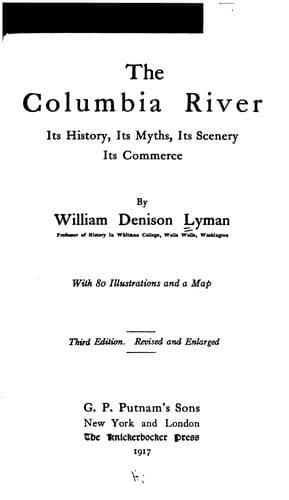
The Columbia River: Its History, Its Myths, Its Scenery, Its CommerceLyman, William Denison
History
The Columbia River: Its History, Its Myths, Its Scenery, Its Commerce
Lyman, William Denison
Columbia River; Columbia River -- Description and travel; Columbia River -- History
For more than three decades after the destruction of the _Tonquin_ there
were no serious Indian conflicts. The Hudson's Bay Company carried out
consistently the general policy of harmony with the natives. Most of the
employees were of French Canadian origin, and, with their general
sociability, they were more popular with the Indians than the Americans
usually have been. But with the incoming of American missionaries,
trappers, explorers, and immigrants, the situation changed. Conflicts of
interests, ambitions, and national aims led both Americans and British to
be somewhat more ready to encourage the hostile and suspicious disposition
of the natives. Chiefly, however, the cause of the changing attitude of
the natives must be attributed to the perception by the more intelligent
of the fact that the actual occupation of the country by white farmers,
home builders, and land owners, meant their own destruction. Though this
truth dawned on them only vaguely and gradually, they had begun to be
somewhat familiar with it by the decade of the thirties.
The founding of American missions during that decade, as narrated earlier,
at Chemeketa, Walla Walla, Lapwai, and Tshimakain, and, during the years
following, the obvious intent of the Americans to draw immigration to the
country, prepared the way for the first and perhaps the most ferocious,
though by no means the greatest, of the four principal wars which we plan
to consider. This first one was the war connected with the Whitman
massacre.
We have already described the founding of the Whitman Mission at
Waiilatpu, six miles from the present site of Walla Walla, and twenty-six
miles from the Hudson's Bay fort on the Columbia, known as Fort Walla
Walla. We have also told of Whitman's journey across the continent in the
mid-winter of 1842-43, of his efforts to secure the attention of Congress
and of the Executive to the importance of the Oregon country, and of his
return to Walla Walla in 1843, with the first large immigration of
American settlers.
After the incoming of this immigration, it became more than ever clear to
the more intelligent Indians that this movement of settlers portended a
change in their whole condition. Their wild life could not co-exist with
farming, houses, and the fixed and narrowed limits of the white man's
life. Moreover, since they saw the antagonism between the Americans and
the Hudson's Bay Company, and since the latter was obviously more
favourable to perpetuating the life of the wilderness, the natives were
naturally drawn into sympathy with the latter. Still further, since the
Americans were Protestants and naturally affiliated with the Whitman
Mission and its associated missions, and since the Hudson's Bay people
were mainly Catholics and interested in maintaining the missionary methods
adapted to the regime of the fur-traders, there became injected into the
situation the dangerous element of religious jealousy.
Public-domain text, read in full here on John Shaqi.
Reviews
Reviews
No reviews yet
Be the first to share your thoughts on this work.
Elsewhere in the archive
Join the Discussion
Join the discussion
Sign in to leave a comment or review.
Sign InorCreate an account