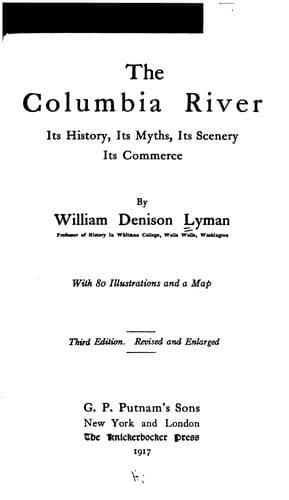
The Columbia River: Its History, Its Myths, Its Scenery, Its CommerceLyman, William Denison
History
The Columbia River: Its History, Its Myths, Its Scenery, Its Commerce
Lyman, William Denison
Columbia River; Columbia River -- Description and travel; Columbia River -- History
Extent of Indian Troubles in the Region of the Columbia--Destruction
of the _Tonquin_--Conflicting Policies of the British and the
Americans in Regard to the Fur-trade--Advances in Settlement by
Americans, and Indian Opposition--The Whitman Mission and its
Relations to the Indians, and to the Hudson's Bay Company--The
Pestilence of 1847--The Whitman Massacre--Mr. Osborne's
Reminiscences--Saving of the Lapwai and Tshimakain Missions--The
Cayuse War--Great War of 1855-56--Kamiakin and Peupeumoxmox--Governor
I. I. Stevens of Washington Territory and his Efforts to Make
Treaties--The Walla Walla Council and the Division among the
Indians--Pearson and his Ride--Outburst of Hostilities and the
Destruction that Followed--Conflict between the Regulars and the
Volunteers--Battles of Walla Walla, Cascades, and Grande Ronde--Second
Walla Walla Council--An Unsatisfactory Peace--Continued Incoming of
Prospectors and Land-seekers--Third Indian War--Disastrous Steptoe
Campaign--Garnett's Campaign in the Yakima--Wright's Campaign to
Spokane and Overthrow of Indian Power--Peace Proclaimed and the
Country Thrown Open to Settlement--Nez Perce War of
1877--Hallakallakeen, or Joseph, the Indian Warchief--His Melancholy
Fate--The Bannock War.
Columbia River history has had its full share of Indian wars. To narrate
these in full would transcend the limits of this chapter. Even during the
era of discovery desperate affrays with the natives were a common
experience of explorers. Captain Gray of the _Columbia_ lost a boat's crew
of seamen at Tillamook. The ship _Boston_ was seized in 1803 by the wily
old chief Maquinna at Nootka.
In 1812 the _Tonquin_, the first vessel of the Pacific Fur Company, in
command of Captain Thorn, was captured at some point to the north of the
Columbia River, variously known as Eyuck Whoola on Newcetu Bay, or Newity
Bay, or Newcetee. She was, as a result of the capture, blown up by the
explosion of her own powder magazine. Gabriel Franchere and Alexander
Ross, of the Astoria party, are the original authorities for this dramatic
story. Irving has made the event a leading feature of his charming
_Astoria_. H. H. Bancroft has discussed it at length in his history of the
Pacific Coast. In recent years Major H. M. Chittenden in his valuable
book, _History of the American Fur Trade_, presents new testimony of much
interest. But whatever discrepencies existed in the records, the general
truth remains that the ship and all her crew, with the exception of one
Indian, disappeared, and great was the loss to the traders at Astoria as a
result.
Public-domain text, read in full here on John Shaqi.
Reviews
Reviews
No reviews yet
Be the first to share your thoughts on this work.
Elsewhere in the archive
Join the Discussion
Join the discussion
Sign in to leave a comment or review.
Sign InorCreate an account