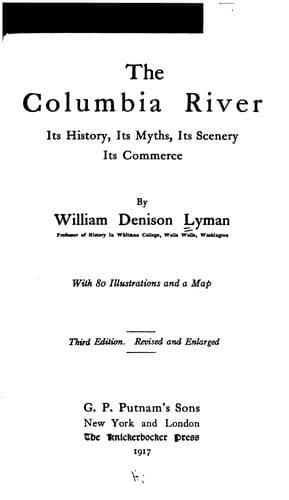
The Columbia River: Its History, Its Myths, Its Scenery, Its Commerce — John Shaqi
The Columbia River: Its History, Its Myths, Its Scenery, Its CommerceLyman, William Denison
History
The Columbia River: Its History, Its Myths, Its Scenery, Its Commerce
Lyman, William Denison
Columbia River; Columbia River -- Description and travel; Columbia River -- History
From the north, moving south, we might gaze at these great peaks, and find
no two alike. Baker--how much finer is the native name, Kulshan, the Great
White Watcher--first on the north; Shuksan next, the place where the
storm-winds gather, in the native tongue; then Glacier Peak, with its
girdle of ice, thirteen great glaciers; Stewart next with its dizzy horn
of rock set in a field of snow; then the great king-peak of all, Rainier,
better named by the natives, Takhoma, the fountain breast of milk-white
waters; and after this, Adams, or in the Indian, Klickitat, with St.
Helens or Loowit near at hand on the west; then, across the Great River,
Hood or Wiyeast, with its pinnacled crest; next southward, Jefferson with
its sharp chimney whose top has never yet been touched by human foot; yet
beyond, the marvellous group of the Three Sisters, each with its separate
personality and yet all together combining in one superb whole; then Mt.
Scott, Mt. Thielson, Diamond Peak, Mt. Pitt, and with them we might well
include the truncated cone of Mt. Mazama, once the lordliest of the chain,
but by some mighty convulsion of nature, shorn of crown and head, and now
bearing on its summit instead the most singular body of water, Crater
Lake, on all the American continent.
Fifteen is the number of the great peaks named, but there are dozens of
lesser heights, snow-crowned and regal. The great Cascade chain is,
therefore, the noblest and most significant feature of the topography of
the land of the Columbia. Between the Rocky Mountains and the Cascades
lies what is locally known as the Inland Empire, mainly a continuous
prairie or series of prairies and valleys, wheat land, orchard land,
garden land, fertile, beautiful, attractive, broken by an occasional
mountain spur, as the irregular mass of the Blue Mountains, but
substantially an inhabited land, reaching from Colville, Spokane, and the
Okanogan on the north to the Klamath valleys on the south, a region five
hundred miles long by two hundred wide, a goodly land, one difficult to
excel in all the potentialities of use for human needs.
Such are the distinguishing features of the Columbia Basin on the east
side of the Cascade Mountains.
To the west of those mountains is another vast expanse of interior
valleys, not so large indeed and not more fertile, but even more
beautiful, and by reason of earlier settlement and contiguity to the
ocean, better developed.
Public-domain text, read in full here on John Shaqi.
Reviews
Reviews
No reviews yet
Be the first to share your thoughts on this work.
Join the Discussion
Join the discussion
Sign in to leave a comment or review.
Sign InorCreate an account