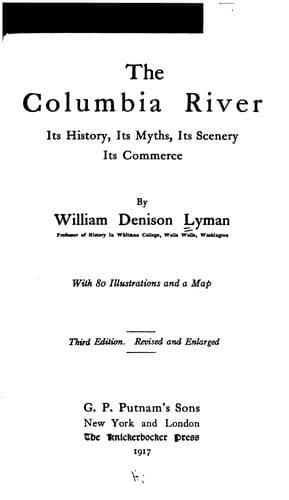
The Columbia River: Its History, Its Myths, Its Scenery, Its CommerceLyman, William Denison
History
The Columbia River: Its History, Its Myths, Its Scenery, Its Commerce
Lyman, William Denison
Columbia River; Columbia River -- Description and travel; Columbia River -- History
Mr. McBean came and asked who was there. I replied. He said he could
not let us in; we must go to Umatilla or he would put us over the
river, as he had Mr. Hall. My wife replied she would die at the gate
but she would not leave. He finally opened and took us into a secret
room and sent an allowance of food for us every day. Next day I asked
him for blankets for my sick wife to lie on. He had nothing. Next day
I urged again. He had nothing to give, but would sell a blanket out of
the store. I told him I had lost everything, and had nothing to pay;
but if I should live to get to the Willamette I would pay. He
consented. But the hip-bones of my dear wife wore through the skin on
the hard floor. Stickus, the chief, came in one day and took the cap
from his head and gave it to me, and a handkerchief to my child.
The Whitman massacre was a prelude to the Cayuse War. It should be
remembered that, the year before the massacre, the Oregon country had, by
treaty with Great Britain, become the property of the United States. No
regular government had yet been inaugurated, but the Provisional
Government already instituted by the Americans met on December 9th and
provided for sending fourteen companies of volunteers to the Walla Walla.
These were immigrants who had come to seek homes and their section of
land, and it was a great sacrifice for them to leave their families and
start in mid-winter for the upper Columbia. But they bravely and
cheerfully obeyed the call of duty and set forth, furnishing mainly their
own equipment, without a thought of pecuniary gain or even reimbursement.
Cornelius Gilliam, an immigrant of 1845 from Missouri, was chosen colonel
of the regiment. He was a man of great energy and courage, and though not
a professional soldier,--none of them were,--had the frontier American's
capacity for warfare. The command pushed rapidly forward, their way being
disputed at various points. At Sand Hollows the Indians, led by Five Crows
and War Eagle, made an especially tenacious attempt to prevent the
crossing of the Umatilla River. Five Crows claimed to have wizard powers
by which he could stop all bullets, and War Eagle declared that he could
swallow all balls fired at him. But at the first onset the wizard was so
badly wounded that he had to retire and "Swallow Ball" was killed. Tom
McKay had levelled his rifle and said, "Let him swallow this."
[Illustration: Grave of Marcus Whitman and his Associate Martyrs at
Waiilatpu. Photo. by W. D. Chapman.]
Public-domain text, read in full here on John Shaqi.
Reviews
Reviews
No reviews yet
Be the first to share your thoughts on this work.
Elsewhere in the archive
Join the Discussion
Join the discussion
Sign in to leave a comment or review.
Sign InorCreate an account