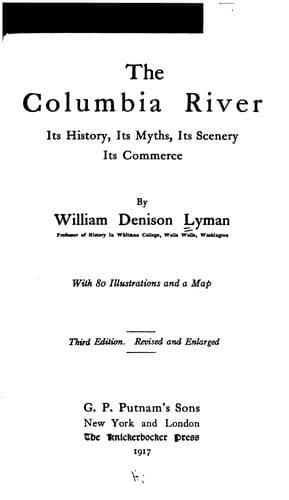
The Columbia River: Its History, Its Myths, Its Scenery, Its CommerceLyman, William Denison
History
The Columbia River: Its History, Its Myths, Its Scenery, Its Commerce
Lyman, William Denison
Columbia River; Columbia River -- Description and travel; Columbia River -- History
The way was now clear to Waiilatpu, which the command reached on March
4th. The mangled remains of the victims of the massacre had been hastily
interred by the Ogden party, but coyotes had partially exhumed them. The
remains were brought together by the volunteers and reverently, though
rudely, buried at a point near the mission, a place where a marble crypt
now encloses the commingled bones of the martyrs. A lock of long, fair
hair was found near the ruined mission ground which was thought surely to
be from the head of Mrs. Whitman. It was preserved by one of the
volunteers and is now one of the precious relics in the historical museum
of Whitman College.
The Cayuse War dragged along in a desultory fashion for nearly three
years. The refusal of the Nez Perces and Spokanes and the indifference of
the Yakimas to join the Cayuses made their cause hopeless, though there
were several fierce fights with them and much severe campaigning. In 1850
a band of friendly Umatilla Indians undertook to capture the chief band of
the Cayuses under Tamsaky, which had taken a strong position about the
head waters of the John Day River. After a savage battle Tamsaky was
killed and most of the warriors captured. Of these, five, charged with the
leading part in the Whitman massacre, were hanged at Oregon City on June
3, 1850. It remains a question to this day, however, whether the victims
of the gallows were really the guilty ones. The Cayuse Indians were quite
firm in their assertion that Tamahas, who, by one version, struck Dr.
Whitman the first blow, was the only one of the five concerned in the
murder.
Thus ended the first principal war in the Columbia Basin. It was quickly
followed by another, which was so extensive that it may be well called
universal. This was the War of 1855-56. This was the greatest Indian war
in the entire history of the Columbia River.
As we have seen, the American home-builders had outmatched the English
fur-traders in the struggle for possession. On the 3d of March, 1853,
Washington Territory, embracing the present States of Washington and
Idaho, with parts of Wyoming and Montana, was created by Act of Congress,
and Isaac I. Stevens was appointed governor. This remarkable man entered
with tremendous energy upon his task of organising the chaos of his great
domain. The Indian problem was obviously the most dangerous and pressing
one. There were at that time two remarkable chiefs of the mid-Columbia
region, natural successors of Philip, Pontiac, Black Hawk, and Tecumseh,
possessing those Indian traits of mingled nobleness and treachery which
have made the best specimens of the race such interesting objects of
study. These Indians were Kamiakin of the Yakimas, and Peupeumoxmox of the
Walla Wallas.
[Illustration: Cayuse Babies 1. (Copyright by Lee Moorehouse, 1898.)]
[Illustration: Cayuse Babies 2. (Copyright by Lee Moorehouse, 1898.)]
Public-domain text, read in full here on John Shaqi.
Reviews
Reviews
No reviews yet
Be the first to share your thoughts on this work.
Elsewhere in the archive
Join the Discussion
Join the discussion
Sign in to leave a comment or review.
Sign InorCreate an account