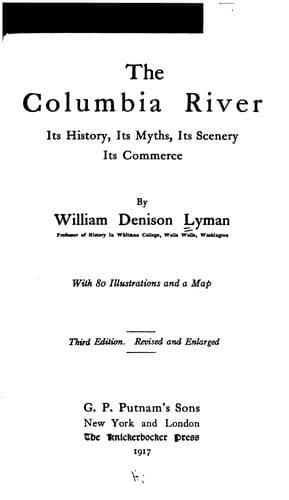
The Columbia River: Its History, Its Myths, Its Scenery, Its CommerceLyman, William Denison
History
The Columbia River: Its History, Its Myths, Its Scenery, Its Commerce
Lyman, William Denison
Columbia River; Columbia River -- Description and travel; Columbia River -- History
In 1855 the great war broke out almost simultaneously at different points.
There were six widely scattered regions especially concerned. Four of
these, the Cascades, the Yakima Valley, the Walla Walla, and the Grande
Ronde, were on or adjacent to the River. The others were the Rogue River
region and Puget Sound. So wide was the area of this war that intelligent
co-operation among the Indians proved impracticable. This, in fact, was
the thing that saved the whites. For there were probably not less than
four thousand Indians on the war-path, and if they had co-operated, the
smaller settlements, possibly all in the country except those in the
Willamette Valley, might have been annihilated.
The first efforts of Governor Stevens were to secure treaties with the
Indians. Having negotiated several treaties in 1854 with the Puget Sound
Indians, the governor passed over the Cascade Mountains to Walla Walla in
May, 1855. There during the latter part of May and first part of June, he
held a great council with representatives of seventeen tribes. Lieutenant
Kip, U. S. A., has preserved a vivid account of this great gathering, one
of the most important ever held in the annals of Indian history. According
to Lieutenant Kip, there were but about fifty men in the escort of the
daring governor, and if he had been a man sensible to fear he might well
have been startled when there came an army of twenty-five hundred Nez
Perces under Halhaltlossot, known as Lawyer by the whites. Two days later
three hundred Cayuses, those worst of the Columbia River Indians, surly
and scowling, led by Five Crows and Young Chief, made their appearance.
Two days later a force of two thousand Yakimas, Umatillas, and Walla
Wallas came in sight under Kamiakin and Peupeumoxmox. The council was soon
organised. Governor Stevens and General Palmer, the latter the Indian
Agent for Oregon, set forth their plan of reservations, all their speeches
being translated and retranslated until they had filtered down among the
general mass of the Indians. Then there must be a great "wawa," or
discussion by the Indians. It soon became apparent that there were two
bitterly contesting parties. One was a large faction of Nez Perces led by
Lawyer, who favoured the whites. The other faction of the Nez Perces, with
all the remaining tribes, were set against any treaty. With remarkable
skill and patience, Governor Stevens, with the powerful assistance of
Lawyer, had brought the Indians to a point of general agreement to the
creation of a system of reservations. But suddenly there was a commotion.
Into the midst of the council there burst the old chief Looking Glass
(Apashwahayikt), second only to Lawyer in influence among the Nez Perces.
He had made a desperate ride of three hundred miles in seven days,
following a buffalo hunt and a raid against the Blackfeet, and as he now
burst into the midst, there dangled from his belt the scalps of several
slaughtered Blackfeet.
Public-domain text, read in full here on John Shaqi.
Reviews
Reviews
No reviews yet
Be the first to share your thoughts on this work.
Elsewhere in the archive
Join the Discussion
Join the discussion
Sign in to leave a comment or review.
Sign InorCreate an account