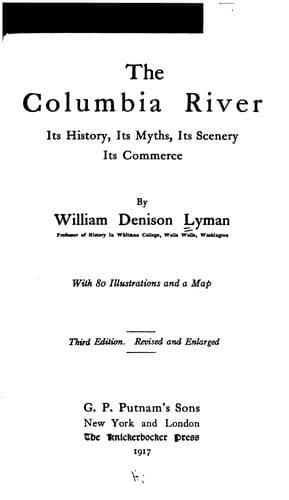
The Columbia River: Its History, Its Myths, Its Scenery, Its CommerceLyman, William Denison
History
The Columbia River: Its History, Its Myths, Its Scenery, Its Commerce
Lyman, William Denison
Columbia River; Columbia River -- Description and travel; Columbia River -- History
Exactly opposite to these was Halhaltlossot, or Lawyer, the Solon of the
Nez Perces. Lawyer became convinced of the existence of this conspiracy
and went by night to the camp of Governor Stevens and revealed it. He
concluded his revelation by saying: "I will come with my family and pitch
my lodge in the midst of your camp, that those Cayuses may see that you
and your party are under the protection of the head chief of the Nez
Perces." When it became clear to the conspiring Cayuses and Yakimas that
Lawyer's powerful division of the Nez Perces was sustaining the little
band of whites, they did not execute their design. Lawyer and his Nez
Perces saved the day for the whites.
And yet the sequel is one of the most lamentable examples of the
miscarriage of justice in Indian affairs that we have any record of. The
friendly Nez Perces saved the whites. The unfriendly faction of the Nez
Perces, led by Joseph and Looking Glass, finally yielded and accepted the
treaty. But they did this with certain expectations in regard to their
reservation. This was set forth to the author by William McBean, a
half-breed Indian, son of the McBean who was the commandant of the
Hudson's Bay post at Wallula. McBean the younger was a boy at the time of
the council at Walla Walla. He was familiar with all the Indian languages
spoken at the council and in appearance was so much of an Indian that he
could pass unquestioned anywhere. Governor Stevens asked him to spy out
the situation and learn what the Nez Perces were going to decide. The
result of his investigations was to show that the whole decision hinged on
the understanding by Joseph's faction that, if they acquiesced in the
treaty and turned their support to the whites, they might retain perpetual
possession of the Wallowa country in North-eastern Oregon as their special
allotment. Becoming finally satisfied that this would be granted them,
they yielded to the Lawyer faction and thus the entire Nez Perce tribe
made common cause with the whites, rendering the execution of the great
plot of Kamiakin and Peupeumoxmox a foredoomed failure. But now for the
sequel. Though it was thus clear in the minds of Joseph and his division
of the Nez Perces that the loved Wallowa (one of the fairest regions that
ever the sun shone on and a perfect land for Indians) was to be their
permanent home, yet the stipulation, if indeed it were intended by
Governor Stevens, never became definitely set down in the "Great Father's"
records at Washington. The result was that when, twenty years later, the
manifold attractions of the Wallowa country began to draw white
immigration, the Indians, now under Young Joseph, son of the former chief,
stood by their supposed rights and the great Nez Perce War of 1877 ensued.
Public-domain text, read in full here on John Shaqi.
Reviews
Reviews
No reviews yet
Be the first to share your thoughts on this work.
Elsewhere in the archive
Join the Discussion
Join the discussion
Sign in to leave a comment or review.
Sign InorCreate an account