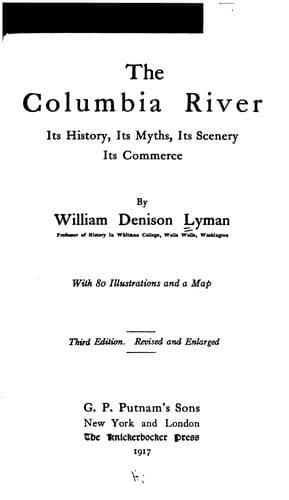
The Columbia River: Its History, Its Myths, Its Scenery, Its CommerceLyman, William Denison
History
The Columbia River: Its History, Its Myths, Its Scenery, Its Commerce
Lyman, William Denison
Columbia River; Columbia River -- Description and travel; Columbia River -- History
And now, to resume the thread of our discourse, we may note that Governor
Stevens proceeded on his laborious mission to the Flatheads in the region
of the Coeur d'Alene and Pend Oreille lakes in what is now Northern
Idaho. After protracted and at times excited discussion, a treaty was
accepted by which an immense tract of a million and a quarter acres was
set apart for a reservation. From Pend Oreille, Governor Stevens with his
little force, now reduced to twenty-two, crossed the Rockies to Fort
Benton.
But what was happening on the Walla Walla? No sooner was the governor
fairly out of sight across the flower-bespangled plains which extended two
hundred miles north-east from Walla Walla, than the wily Kamiakin began to
resume his plots. So successful was he, with the valuable assistance of
Peupeumoxmox, Young Chief, and Five Crows, that the treaties, just
ratified, were torn to shreds, and the flame of savage warfare burst forth
across the entire Columbia Valley.
Hazard Stevens, in his invaluable history of his father, gives a vivid
picture of how the news reached them in their camp thirty-five miles up
the Missouri from Fort Benton. Summer had now passed into autumn. A
favourable treaty had been made with the Blackfeet. On October 29th, the
little party were gathered around their campfire in the frosty air of fall
in that high latitude, when they discerned a solitary rider making his way
slowly toward them. As he drew near they soon saw that it was Pearson, the
express rider. Pearson was one of the best examples of those scouts whose
lives were spent in conveying messages from forts to parties in the field.
He usually travelled alone, and his life was always in his hand. He seemed
to be made of steel springs, and it had been thought that he could endure
anything. "He could ride anything that wore hair." He rode seventeen
hundred and fifty miles in twenty-eight days at one time, one stage of two
hundred and sixty miles having been made in three days. But as he slowly
drew up to the party in the cold evening light, it was seen that even
Pearson was "done." His horse staggered and fell, and he himself could not
stand or speak for some time. After he had been revived he told his story,
and a story of disaster and foreboding it was, sure enough.
Public-domain text, read in full here on John Shaqi.
Reviews
Reviews
No reviews yet
Be the first to share your thoughts on this work.
Elsewhere in the archive
Join the Discussion
Join the discussion
Sign in to leave a comment or review.
Sign InorCreate an account