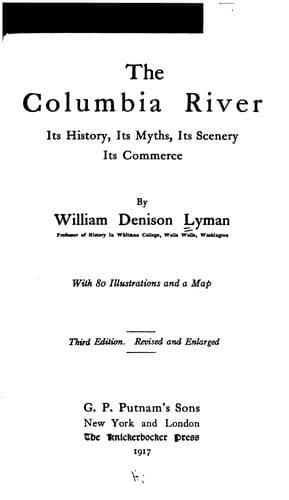
The Columbia River: Its History, Its Myths, Its Scenery, Its CommerceLyman, William Denison
History
The Columbia River: Its History, Its Myths, Its Scenery, Its Commerce
Lyman, William Denison
Columbia River; Columbia River -- Description and travel; Columbia River -- History
After many adventures, Governor Stevens reached Olympia in safety.
Governor Curry of Oregon had already called a force of volunteers into the
field. The Oregon volunteers were divided into two divisions, one under
Colonel J. W. Nesmith, which went into the Yakima country, and the other
under Lieutenant-Colonel J. K. Kelley, which went to Walla Walla. The
latter force fought the decisive battle of the campaign on the 7th, 8th,
9th, and 10th of December, 1855. It was a series of engagements occurring
in the heart of the Walla Walla Valley, a "running fight" culminating at
what is now called Frenchtown, ten miles west of the present city of Walla
Walla. The most important feature of it all was the death of the great
Walla Walla chieftain, Peupeumoxmox. But though defeated and losing so
important a chief, the Indians scattered across the rivers and were still
unsubdued.
In March, 1856, the sublime section of the Columbia lying between The
Dalles and the Cascades became the scene of a series of atrocities the
most distressing in the entire war. The Klickitats swooped down upon the
defenceless settlers and massacred them with revolting cruelty. They
vanished like a whirlwind, but men whom the writer has known have related
to him how the volunteers, returning to the scenes of desolation, found
all houses destroyed and the carcasses of cattle thrown into the springs
and wells. They found the naked bodies of the girls and women with stakes
driven through, and those of men horribly mutilated. In savage humour, the
Indians had killed the hogs and left parts of human bodies in their
mouths. One interesting fact connected with the campaign at the Cascades
is that General Phil Sheridan fought his first battle there. The old Block
House on the north side of the River, nearly opposite the present Cascade
Locks, existed until a few years ago, and there was Sheridan's first
battle.
Meanwhile Governor Stevens had organised a force of Washington volunteers.
As the year 1856 progressed, it seemed more plain that the discord which
developed between the regulars under command of General John E. Wool and
the volunteers would result in fatal weakness. Nevertheless Governor
Stevens and Governor Curry kept pressing the movements of their backwoods
soldiers with unflagging energy. They were at last rewarded with a measure
of success. For Colonel B. F. Shaw, commanding the Washington volunteers,
learning that the hostiles were camped in force in the Grande Ronde
Valley, made a rapid march from Walla Walla across the western spur of the
Blue Mountains and struck the collected force of Indians a deadly blow,
scattering them in all directions and ending the war in that quarter.
Public-domain text, read in full here on John Shaqi.
Reviews
Reviews
No reviews yet
Be the first to share your thoughts on this work.
Elsewhere in the archive
Join the Discussion
Join the discussion
Sign in to leave a comment or review.
Sign InorCreate an account