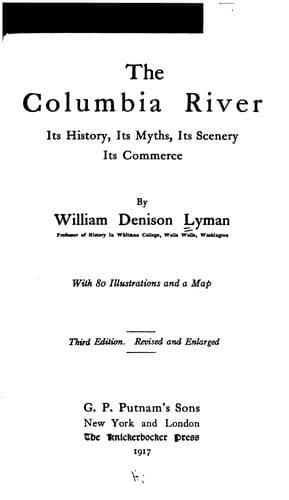
The Columbia River: Its History, Its Myths, Its Scenery, Its CommerceLyman, William Denison
History
The Columbia River: Its History, Its Myths, Its Scenery, Its Commerce
Lyman, William Denison
Columbia River; Columbia River -- Description and travel; Columbia River -- History
But the end had not yet come in Walla Walla. Governor Stevens determined
to hold another great council at the site of the first. Leaving The Dalles
on August 19th, he pressed on to Shaw's camp, two miles above the
present location of Walla Walla. On September 5th, Colonel E. J. Steptoe,
with four companies of regulars, arrived at the same place and made camp
on the site of the present fort.
[Illustration: Col. B. F. Shaw, who Won the Battle of Grande Ronde in
1856. By Courtesy of Major Lee Moorehouse.]
And now came on the second great Walla Walla council. The tribes were
gathered as before, and were aligned as before. The division of Nez Perces
under Lawyer stood firmly by Stevens and the treaty. The others did not.
The most unfortunate feature of the entire matter was that Colonel
Steptoe, acting under General Wool's instructions, thus far kept secret,
refused to grant Stevens adequate support and subjected him to
humiliations which galled the fiery Governor to the limit. In fact, had it
not been for the vigilance of the faithful Nez Perces of Lawyer's band,
Stevens and his force would surely have met the doom prepared for them at
the first council. The debt of gratitude due Lawyer is incalculable.
Spotted Eagle ought to be recorded, too, as of similar devotion and
watchfulness. Governor Stevens afterward declared that a speech by him in
favour of the whites was equal in feeling, truth, and courage to any
speech that he ever heard from any orator whatever.
But in spite of oratory, zeal, and argument, nothing could overcome the
influence of Kamiakin, Owhi, Quelchen, Five Crows, and others of the
Yakimas and Cayuses. Nothing was gained. They stood just where they were a
year before. The fatal results of divided counsels between regulars and
volunteers were apparent.
The baffled Governor now started on his way down the River, but not
without another battle. For, as he was marching a short distance south of
what is now Walla Walla city, the Indians burst upon his small force with
the evident intention of ending all scores then and there. But Colonel
Steptoe came to the rescue, and with united forces the Indians were
repulsed.
That was the last battle on the Walla Walla. Colonel Steptoe established a
rude stockade fort on Mill Creek in what is now the heart of the present
Walla Walla city, and went into winter quarters there in 1856-57. Governor
Stevens returned to Olympia and launched forth a bitter arraignment
against Wool. The latter, however, was in a position of vantage and issued
a proclamation commanding all whites in the upper country to go down the
River and leave the Cascade Mountains as the eastern limit of the white
settlement. Thus ended for a time this unsatisfactory and distressing war.
To all appearances Kamiakin and his adherents had accomplished all they
wanted.
Public-domain text, read in full here on John Shaqi.
Reviews
Reviews
No reviews yet
Be the first to share your thoughts on this work.
Elsewhere in the archive
Join the Discussion
Join the discussion
Sign in to leave a comment or review.
Sign InorCreate an account