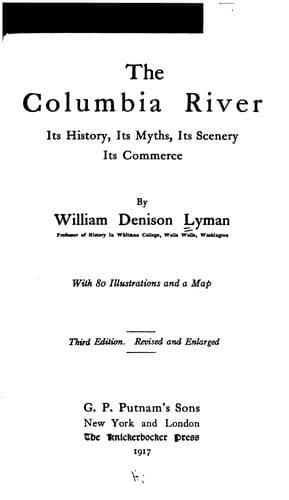
The Columbia River: Its History, Its Myths, Its Scenery, Its CommerceLyman, William Denison
History
The Columbia River: Its History, Its Myths, Its Scenery, Its Commerce
Lyman, William Denison
Columbia River; Columbia River -- Description and travel; Columbia River -- History
On May 16, 1858, the force reached a point near four lakes, probably the
group of which Silver Lake and Medical Lake are the chief ones, a few
miles west of Spokane. Here was gathered a formidable array, Spokanes,
Pend Oreilles, Coeur d'Alenes, Okanogans, and Colvilles, the hosts of
the upper country. Steptoe was soldier enough to perceive that it was time
for caution, and he halted for a parley. Saltese, a brawny chief of the
Coeur d'Alenes, declared to him that the Indians were ready to dispute
his farther progress, but that if the white men would retire the Indians
would not molest them. A friendly Nez Perce, seeing the duplicity of
Saltese, struck his mouth, exclaiming, "You speak with a double tongue."
The force turned back and that night all seemed well. But at nine o'clock
the next morning, while the soldiers were descending a canyon to Pine
Creek, near the present site of Rosalia, a large force of Indians burst
upon them like a cyclone. As the battle began to wax hot, the terrible
consequences of the error of lack of ammunition began to become manifest.
Man after man had to cease firing. Captain O. H. P. Taylor and Lieutenant
Gaston commanded the rear-guard. With extraordinary skill and devotion
they held the line intact and foiled the efforts of the savages to burst
through. Meanwhile the whole force was moving as rapidly as consistent
with formation on their way southward. Taylor and Gaston sent a messenger
forward, begging Steptoe to halt the line and give them a chance to load.
But the commander felt that the safety of the whole force depended on
pressing on. Soon a fierce rush of Indians followed, and, when the surge
had passed, the gallant rear-guard was buried under it. One notable figure
in the death-grapple was De May, a Frenchman, trained in the Crimea and
Algeria, and an expert fencer. For some time he used his gun barrel as a
sword and swept the Indians down by dozens with his terrific sweeps. But
at last he fell before numbers, and one of his surviving comrades relates
that he heard him shouting his last words, "O, my God, my God, for a
sabre!"
Public-domain text, read in full here on John Shaqi.
Reviews
Reviews
No reviews yet
Be the first to share your thoughts on this work.
Elsewhere in the archive
Join the Discussion
Join the discussion
Sign in to leave a comment or review.
Sign InorCreate an account