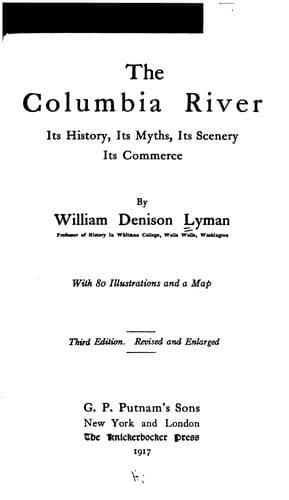
The Columbia River: Its History, Its Myths, Its Scenery, Its CommerceLyman, William Denison
History
The Columbia River: Its History, Its Myths, Its Scenery, Its Commerce
Lyman, William Denison
Columbia River; Columbia River -- Description and travel; Columbia River -- History
But this was not the end. Gold had been discovered in Eastern Washington.
Vast possibilities of cattle raising were evident on those endless
bunch-grass hills. Although there was as yet little conception of the
future developments of the Inland Empire in agriculture and gardening, yet
the keen-eyed immigrants and volunteers had scanned the pleasant vales and
abounding streams of the Walla Walla and the Umatilla and the Palouse, and
had decided in their own minds that, Wool or no Wool, this land must be
opened. In 1857 the Government decided on a change of policy and sent
General N. S. Clarke to take Wool's place. General Clarke opened the
gates, and the impatient army of land hunters and gold hunters began to
move in. Meanwhile, Colonel Wright and Colonel Steptoe, though formerly
they had closely followed Wool's policy, now began to experience a change
of heart. Out of these conditions the third Indian war, in 1858, quickly
succeeded the second, being indeed its inevitable sequence.
[Illustration: Fort Sheridan on the Grande Ronde, Built by Philip Sheridan
in 1855. By Courtesy of Major Lee Moorehouse.]
Three campaigns marked this third war. The first was conducted by Colonel
Steptoe against the Spokanes and Coeur d'Alenes, and ended in his
humiliating and disastrous defeat. The second was directed by Major
Garnett against the Yakimas, resulting in their permanent overthrow. The
third was conducted by Colonel Wright against the Spokanes and other
northern tribes who had defeated Steptoe. This was the Waterloo of the
Indians, and it ushered in the occupation and settlement of the upper
Columbia country.
The Steptoe expedition was the most ill-starred event in the whole history
of the North-west, unless we except that of the destruction of the
_Tonquin_. Colonel Wright was then in command of the new Fort Walla Walla,
located in 1857 on the present ground. Perceiving his former error in
giving the turbulent and treacherous natives undisputed sway, he ordered
Colonel Steptoe to go with two hundred dragoons to the Spokane region and
subject the restless tribes centring there. Steptoe's force was well
equipped in every way except one. The pack train was heavily laden, and an
inebriated quartermaster conceived the brilliant idea of lessening the
burden by _leaving out the larger part of the ammunition_. Even aside from
this fatal blunder, Colonel Steptoe seems to have had no adequate
conception of the vigour and resources of the Indians.
As before, the Nez Perces were the faithful friends of the whites.
Timothy, a Nez Perce chief living on Snake River at the mouth of the
Alpowa, put them across the wicked stream, then running high with the May
freshet, and went on with them as guide.
Public-domain text, read in full here on John Shaqi.
Reviews
Reviews
No reviews yet
Be the first to share your thoughts on this work.
Elsewhere in the archive
Join the Discussion
Join the discussion
Sign in to leave a comment or review.
Sign InorCreate an account