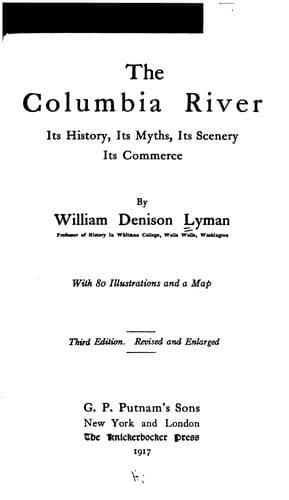
The Columbia River: Its History, Its Myths, Its Scenery, Its CommerceLyman, William Denison
History
The Columbia River: Its History, Its Myths, Its Scenery, Its Commerce
Lyman, William Denison
Columbia River; Columbia River -- Description and travel; Columbia River -- History
In 1838 a gay, mercurial Switzer, Captain Sutter, had made his way with a
band of trappers across the plains to Oregon, and thence had gone to
California. A dashing adventurer, without money, but with boundless
_sang-froid_ and _bonhommie_, Sutter had marvellously interested all whom
he met and in some inexplicable manner had got money and credit sufficient
to build a fort and start an immense ranch on the Sacramento, almost on
the site of the present capital of the Golden State. "Sutter's fort"
became one of the most notable places in California. In 1844 James W.
Marshall went to the Columbia, but after only a year's stay made his way
to California. In 1847 he entered into partnership with Sutter in a
sawmill enterprise at Coloma on the south fork of the American River.
There, while at work in the mill-race on the 19th of January, 1848,
Marshall discovered shining particles. Gold!
The discovery was made, and soon the secret was out. And then--! There
never was anything quite comparable to what followed. The first and
greatest of the great stampedes for gold took place.
When the tidings reached Oregon it was as though a prairie fire were
running over the country. Men went fairly mad. Throngs, hardly stopping to
take their ploughs from the furrow, mounted their horses, galloped off up
the Willamette, through the lonely valleys of the Umpqua and the Rogue
River, over the Siskiyou, and down the Sacramento, where a fortune could
be had for the digging.
All the stress and strain of American life and history reached the utmost
intensity in the fever strife for gold on the Sacramento. The Willamette
and Columbia were almost equally stirred. During the first two years of
the gold excitement homes on the Columbia were well-nigh deserted. Then
the Oregonians began to drift back again. Some came with gold-bricks in
their pockets and sacks of gold-dust in their packs. Some came broken in
health and spirits, sick with disappointment. Some did not come at all,
and their bones found unmarked graves in the pestilential ditches of the
Sacramento.
But the shrewder Oregonians perceived that they had better than a gold
mine in the trade with California. Grain, fruit, eggs, lumber,--these were
in such demand that frequently twenty ships at a time were moored by the
dense forests of the lower Willamette waiting for cargoes. Gold-dust was
the universal medium, and it seemed to be cheaper than anything else. Four
bushels of Oregon apples brought five hundred dollars in gold-dust in San
Francisco. Tons of eggs were sold for a dollar apiece in the gold mines.
Portland, the lonely little village on the Willamette, with just enough of
a foothold by the edge of the forest to keep from rolling into the River,
sprang at a bound into the rank of a city. The huge firs were dug out, and
wharves went in. The face of nature, even, as well as that of industry and
politics, was transformed by that gold-dust in Marshall's mill-race on the
Sacramento.
Public-domain text, read in full here on John Shaqi.
Reviews
Reviews
No reviews yet
Be the first to share your thoughts on this work.
Elsewhere in the archive
Join the Discussion
Join the discussion
Sign in to leave a comment or review.
Sign InorCreate an account