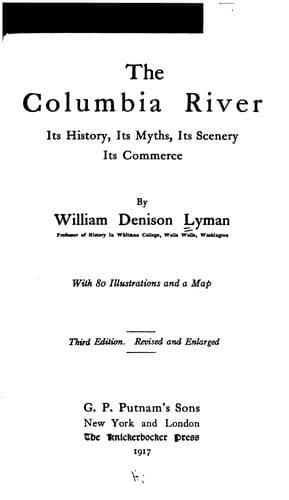
The Columbia River: Its History, Its Myths, Its Scenery, Its CommerceLyman, William Denison
History
The Columbia River: Its History, Its Myths, Its Scenery, Its Commerce
Lyman, William Denison
Columbia River; Columbia River -- Description and travel; Columbia River -- History
The climate of the Columbia Basin is a puzzle to the stranger, but in most
of its aspects it quickly becomes an equal delight. As is well known, the
Japan ocean current exercises upon the Pacific Coast an effect similar to
that of the Gulf Stream on Ireland and England. Hence the states of the
Columbia Valley are much warmer in winter than regions of the same
latitude on the Atlantic Coast or in the Mississippi Valley. Though the
average temperature is higher, yet it is cooler in summer on the Pacific
Coast than on the Atlantic. The Pacific climate has much less of extremes.
The State of Washington has about the same isothermal line as North
Carolina. There is, however, another feature of the Columbia climate not
so well known to non-residents, which is worthy of a passing paragraph.
This is the division of the country by the Cascade Mountains into a humid
western section and a dry eastern one. The mountain wall intercepts the
larger part of the vapour rising from the Pacific and flying eastward, and
these warm masses of vapour are condensed by the icy barrier and fall in
rain on the western side. Hence Western Oregon and Washington are damp and
soft, with frequent clouds and fogs. The rainfall, though varying much, is
in most places from forty to fifty inches a year. But east of the mountain
wall which has "milked the clouds," the air is clear and bright, the sun
shines most of the year from cloudless skies, and there seems to be more
of tingle and electricity in the atmosphere. The rainfall ranges from ten
to thirty inches, and in the drier parts vegetation does not flourish
without irrigation.
Any view of primeval Oregon would be incomplete without a glimpse of the
native race, that melancholy people, possessed of so many interesting and
even noble traits, whose sad lot it has mainly been to struggle against
the advent of a civilisation which they could not understand nor resist,
and before which they have melted away in pitiful impotency. But they have
at least had the highest dignity of defeat, for they have died fighting.
They have realised the conception of the Roman Emperor: "_Me stantem mori
oportet_."
The Oregon Indians have essentially the same characteristic traits as
other Indians, secretiveness, patience, vindictiveness, stoicism; and, in
their best state, fidelity and boundless generosity to friends.
Public-domain text, read in full here on John Shaqi.
Reviews
Reviews
No reviews yet
Be the first to share your thoughts on this work.
Join the Discussion
Join the discussion
Sign in to leave a comment or review.
Sign InorCreate an account