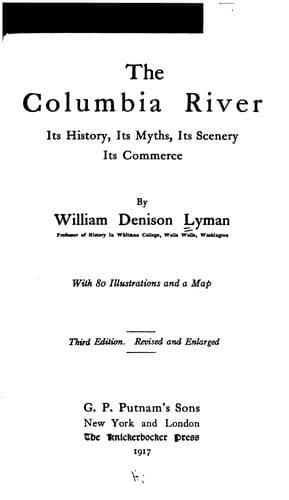
The Columbia River: Its History, Its Myths, Its Scenery, Its CommerceLyman, William Denison
History
The Columbia River: Its History, Its Myths, Its Scenery, Its Commerce
Lyman, William Denison
Columbia River; Columbia River -- Description and travel; Columbia River -- History
Transportation problems followed close upon the cowboy and the miner. The
Oregon Steam Navigation Company, organised in 1860, began within a year to
run steamboats from Portland to Lewiston, with portage railroads around
the Cascades and the Dalles. Stage lines were started from Umatilla, Walla
Walla, and Lewiston, within a year or two after the gold discoveries of
Oro Fino. Prairie-schooners, huge waggons, sometimes three in tandem
fashion, drawn by a team of twenty mules, with jingling bells, driven with
a "single line," formed the approved system of hauling freight over the
mountain roads. In addition to the stages and prairie-schooners, however,
thousands of mules and horses were driven with pack-saddles over the
trails and roads. Then was the time when "throwing the diamond hitch"
became a fine art. Then was the time, too, when it behooved stage-drivers
and packers to be handy with a "gun," for "road-agents" were plentiful and
vigilant. Many a man with a pack-saddle loaded with gold-dust, or
sometimes with whiskey or even "canned goods," "passed in his checks"
under some over-shadowing tree or behind some sheltering rock.
Both the distresses and the successes of that epoch are well illustrated
by extracts from some of the newspapers of the time. From issues of the
_Washington Statesman_ of Walla Walla, we learn that flour was at one time
a dollar a pound; beef, thirty to fifty cents a pound; bacon, sixty;
beans, thirty; rice, fifty; tea a dollar and a half; tobacco, a dollar and
a half; sugar, fifty cents; candles, a dollar. Some of these staples could
not be had at all. Physicians, when they got into the mines, would charge
twenty dollars a visit. Board was from five to ten dollars a day,
frequently more.
But as an offset to the expense and frequent positive suffering, we gather
the following item from an issue of the _Statesman_ in December, 1861:
S. F. Ledyard arrived last evening from the Salmon River mines, and
from him it is learned that some six hundred miners would winter
there; that some two hundred had gone to the south side of the river,
where two streams head that empty into the Salmon, some thirty miles
south-east of the present mining camp. Coarse gold is found, and as
high as one hundred dollars per day to the man has been taken out. The
big mining claim of the old locality belongs to Mr. Weiser of Oregon,
from which two thousand six hundred and eighty dollars were taken out
on the 20th, with two rockers. On the 21st, three thousand three
hundred and sixty dollars were taken out with the same machines.
The _Statesman_ for December 13, 1861, contains the following:
Public-domain text, read in full here on John Shaqi.
Reviews
Reviews
No reviews yet
Be the first to share your thoughts on this work.
Elsewhere in the archive
Join the Discussion
Join the discussion
Sign in to leave a comment or review.
Sign InorCreate an account