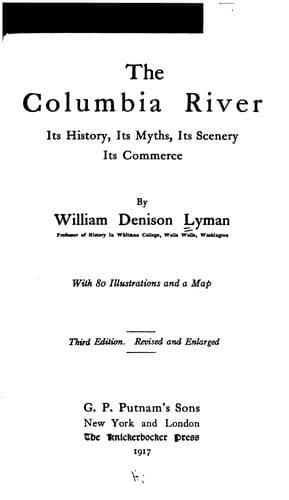
The Columbia River: Its History, Its Myths, Its Scenery, Its CommerceLyman, William Denison
History
The Columbia River: Its History, Its Myths, Its Scenery, Its Commerce
Lyman, William Denison
Columbia River; Columbia River -- Description and travel; Columbia River -- History
During the week past not less than two hundred and twenty-five pack
animals, heavily laden with provisions, have left this city for the
mines. A report in relation to a rich strike by Mr. Bridges of Oregon
City seems to come well authenticated. The first day he worked on his
claim (near Baboon Gulch) he took out fifty-seven ounces; the second
day he took out one hundred and fifty-seven ounces; the third day, two
hundred and fourteen ounces; and the fourth day, two hundred ounces in
two hours.
As an ounce of gold was worth sixteen dollars, it will be seen that Mr.
Bridges of Oregon City had truly "struck it rich."
Within a year, a million and a half dollars in gold-dust had been taken
from those mines. Anticipated demands led cattlemen to rush still larger
numbers of stock into the upper Columbia Basin, and traders brought in yet
larger supplies of goods into Walla Walla and Lewiston, as well as the
mining camps themselves. A considerable part of these goods, we regret to
narrate, consisted of material for spirituous refreshments. That the said
refreshments were of a stalwart character may be inferred from a
reminiscence of a traveller to Walla Walla, who relates that upon going
into one of the numerous saloons, he found the floor covered with sawdust,
and upon asking for whiskey, he received with it a whisk-broom. Feeling
puzzled as to the intent of the latter, and not wishing to reveal his
ignorance, he waited till another man came in. Waiting for developments,
he found that the object of the broom was to sweep off a place on the
floor to have a fit on, for the whiskey was sure to produce one. After
having got through his fit, the happy (?) purchaser would return the broom
and go on his way.
[Illustration: An Oregon Pioneer in his Cabin. Photo. by E. H.
Moorehouse.]
Just as miners, cowboys, and traders were plunging eagerly into every form
of enterprise, the famous "hard winter" of '61 descended upon the country.
It was almost a Minnesota winter. There was snow on the ground from
December 1st to March 22d, something never known before or since in the
Columbia Basin. Cattle could find no food and perished by the thousands.
Miners were found frozen into the stiff crust. In the rude cabins, with
wide cracks into which the snow drifted, the few women and children in the
Inland Empire fought a distressing and frequently losing fight. Even in
the Willamette Valley where houses were more comfortable, supplies more
plentiful, and the weather less severe, the conditions were hard enough.
At Portland the price of hay was eighty dollars a ton. In Eastern Oregon
it could not be obtained for any price, and the maintenance of life by
cattle depended entirely on their endurance.
But with the coming on of tardy spring, the rush up the River was resumed,
and the game went on. Seven millions in gold was reported in 1862, besides
almost as much, as was estimated, taken out in ways of which no record was
reported.
Public-domain text, read in full here on John Shaqi.
Reviews
Reviews
No reviews yet
Be the first to share your thoughts on this work.
Elsewhere in the archive
Join the Discussion
Join the discussion
Sign in to leave a comment or review.
Sign InorCreate an account