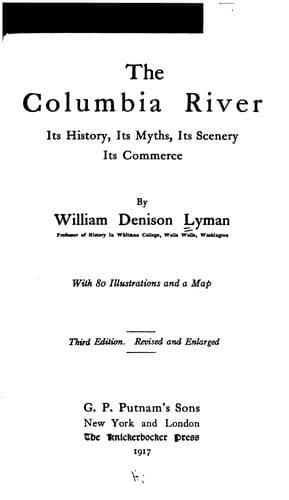
The Columbia River: Its History, Its Myths, Its Scenery, Its CommerceLyman, William Denison
History
The Columbia River: Its History, Its Myths, Its Scenery, Its Commerce
Lyman, William Denison
Columbia River; Columbia River -- Description and travel; Columbia River -- History
At Florence in February, 1862, flour was a dollar a pound; butter, three
dollars; sugar, a dollar and a quarter; coffee, two dollars; boots, thirty
dollars a pair.
The enormous profits, as well as enormous expense, of developing those
mines hastened the coming of the farmer. Among the throng that passed
madly into the mountains for gold, and among the throng that drove the
wide-horned cattle over the bunch-grass hills, there were a few keen-eyed
observers who asked themselves if wheat and corn and potatoes and barley
and fruit-trees might not grow on those broad prairies, and especially
along the numerous watercourses descending from the Blue Mountains.
A farm here and there at some favourable point beside some favouring
stream, followed in two or three years by a flour-mill, then a few apples
whose bright red cheeks and fragrant smell showed that the upper Columbia
lands could match those of the Willamette, then an experimental
wheat-field or barley-field on the high bunch-grass prairies,--and, almost
before people realised it, the farmer was standing up beside the miner and
the stockman, as tall and broad and important as either. The plough and
the hoe and the mowing-machine took their places beside the pick and
gold-pan and quirt and schapps and spurs as symbols of Columbia River
nobility.
The "boomer" was the logical result of the development of mine and range
and farm and garden and orchard. If people were going to eat and travel
and raise wheat and cattle, they must inevitably buy and sell. And if they
were going to buy and sell, they must needs "boom." The decade of the
eighties was the great age of the boom in real estate along the Columbia
and its tributaries. Then, as also upon Puget Sound, cities were founded
with most extravagant size and expectations--on paper. Farm lands changed
hands rapidly. If a man could raise nothing else on his land, he could at
least raise the price. That was the time when the boomer boomed, the
promoter promoted, and the sucker sucked. It was a great age, but alas, it
was followed by an awakening, similar to that which follows a night of
carousal, when the next day brings a dark-brown taste in the mouth and a
very heavy head. The decade of the nineties was dolorous along the River
and in the mines and forests and farms and town-lots and additions and
suburbs adjoining.
[Illustration: Old Portage Railroad at Cascades in 1860.]
[Illustration: A Log-boom Down the River for San Francisco. Photo. by
Woodfield.]
Interlocked with the days of miner, cowboy, rancher, and boomer, was
another age of equal importance and one that was both result and cause of
the others. This was the age of the railroad builder.
Public-domain text, read in full here on John Shaqi.
Reviews
Reviews
No reviews yet
Be the first to share your thoughts on this work.
Elsewhere in the archive
Join the Discussion
Join the discussion
Sign in to leave a comment or review.
Sign InorCreate an account