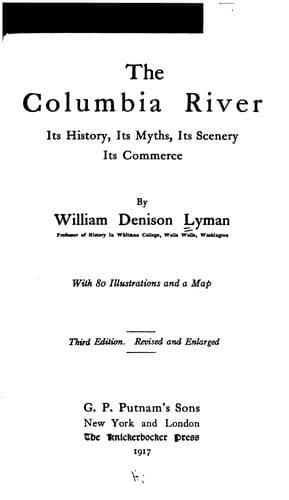
The Columbia River: Its History, Its Myths, Its Scenery, Its CommerceLyman, William Denison
History
The Columbia River: Its History, Its Myths, Its Scenery, Its Commerce
Lyman, William Denison
Columbia River; Columbia River -- Description and travel; Columbia River -- History
In 1879 there came to Oregon the greatest railroad builder of that era,
Henry Villard. He was a true financial genius, daring, far-seeing,
persistent, and self-reliant. With the quick grasp of a statesman, Mr.
Villard perceived that the Columbia River was the key to a boundless
opportunity. He saw that a central line up the Columbia with branches
north, east, and south-east, might be thrust like a wedge between the
Northern Pacific and the Union Pacific and control both. In pursuance of
this conception he made three rapid moves. The first was the
incorporation of the Oregon Railway and Navigation Company. The second was
the formation of the "blind pool" and the Oregon and Transcontinental
Company. The third was the acquisition of a controlling interest in the
Northern Pacific Railroad. The three years up to and including 1883 were
years of almost feverish activity along the River. The line of the Oregon
Railroad and Navigation Company between Wallula and Portland was pushed on
with tireless energy. Rock bluffs were split off by enormous charges of
dynamite, or were tunnelled through. The road was indeed built so hastily
and the curves were in some cases so extreme that much work had to be done
over at later times.
[Illustration: Lumber Mill and Steamboat Landing at Golden, B. C. Photo.
by C. F. Yates.]
A part of Villard's plan in pushing the work so hastily was to divert the
Northern Pacific system to the River, and make Portland rather than Puget
Sound the western terminus. The undertaking seemed to be crowned with
success. The connection was made. A gorgeous celebration, the greatest
ever held in the Columbia River country, commemorated, in October, 1883,
the completion of the transcontinental railroad to tide-water on the
Columbia River. But in the very hour of victory, the sceptre fell from
Villard's hands. His downfall was as sudden and dramatic as his rise. By
clever jobbing of the market, the Wright interests regained possession of
the majority of the Northern Pacific stock, the transcontinental pool
broke, and at the very time that Mr. Villard was being worshipped at
Portland as the financial god of the North-west, he learned that his
gigantic enterprise had fallen into the hands of the enemy. But in spite
of defeat the work of Villard was assured, and his name and fame as the
champion railroad builder of the Columbia River was established.
Public-domain text, read in full here on John Shaqi.
Reviews
Reviews
No reviews yet
Be the first to share your thoughts on this work.
Elsewhere in the archive
Join the Discussion
Join the discussion
Sign in to leave a comment or review.
Sign InorCreate an account