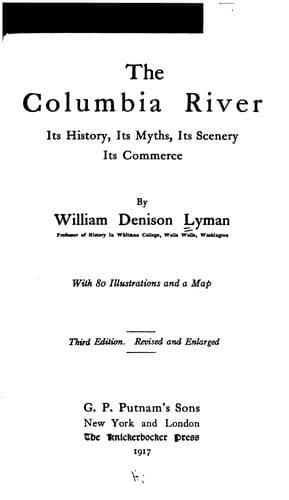
The Columbia River: Its History, Its Myths, Its Scenery, Its CommerceLyman, William Denison
History
The Columbia River: Its History, Its Myths, Its Scenery, Its Commerce
Lyman, William Denison
Columbia River; Columbia River -- Description and travel; Columbia River -- History
After the Wright interests had regained possession of the Northern
Pacific, that great system was pushed to Puget Sound. The Oregon Short
Line was carried to a connection with the Union Pacific system. Thus two
independent transcontinental lines reached the River. Yet later the
Southern Pacific system acquired control of the Oregon and California
Railroad, and, by joining the sections, connected the Columbia River with
the Golden Gate. Through connecting lines the Canadian Pacific Railroad
gained access to the Columbia River. There are, therefore, four distinct
transcontinental railroad systems into the valley of our River. Two more
are rapidly approaching completion. As a logical result, too, many local
and connecting lines have been built. The Astoria and Columbia River
Railroad, on the Oregon side of the River, joins Portland to Astoria and
Seaside and the other resorts of the ocean beach. The Oregon Railway and
Navigation Company has continuous connection on the south side of the
Columbia and Snake rivers to Riparia on the latter stream, and thence by a
road on the north side, owned jointly with the Northern Pacific, to
Lewiston, Idaho. The most remarkable of all these connecting and joint
roads is the Portland, Seattle, and Spokane Railroad, commonly called the
"North Bank Road." This is supposed to be the joint property of the
Northern Pacific and Great Northern railroads. It is one of the many
monuments in the West to the financial genius and tireless energy of James
J. Hill. It was completed in 1908, between Pasco and Portland, and at
the first of the year following, from Pasco to Spokane. It is said to be
the most expensively and scientifically built road in the United States,
having curves and grades reduced to a minimum, being, in fact, a
continuous descent from near Spokane to tide-water. Its builders evidently
expect stupendous traffic, and every feature of the line is adjusted to
such expectation.
[Illustration: A Typical Lumber Camp. Photo. by Trueman.]
Any account of the great railroads joining the Inland Empire to the River
and thence to the seaboard would be incomplete without reference to the
pioneer of them all, the "Strap-iron" narrow-gauge from Walla Walla to
Wallula. This line was forced by the exigencies of the times, but it
commemorates the rare commercial foresight and ability of a man, who, in
native business genius, ranks with the foremost in the history of the
Columbia Valley. This man was Dr. D. S. Baker, a native of Illinois, an
immigrant to the Columbia in 1848, and a settler in Walla Walla in 1860.
Perceiving the vast latent resources of the Inland Empire, he invested in
land, founded a bank, became a partner in a store, and during much of the
time was also actively engaged in his profession of medicine.
Public-domain text, read in full here on John Shaqi.
Reviews
Reviews
No reviews yet
Be the first to share your thoughts on this work.
Elsewhere in the archive
Join the Discussion
Join the discussion
Sign in to leave a comment or review.
Sign InorCreate an account