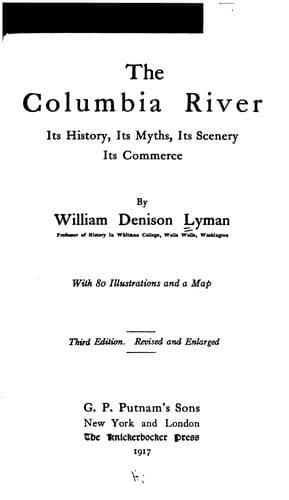
The Columbia River: Its History, Its Myths, Its Scenery, Its CommerceLyman, William Denison
History
The Columbia River: Its History, Its Myths, Its Scenery, Its Commerce
Lyman, William Denison
Columbia River; Columbia River -- Description and travel; Columbia River -- History
A journey upon the River may best begin with its source and end with the
ocean. It is about fourteen hundred miles by the windings of the stream
from its origin in the upper Columbia Lake to the Pacific. It descends
twenty-five hundred feet in that distance. It is therefore swift in many
places. Yet it would be possible to descend almost the entire length of
the River in a small boat. Nor can one imagine a more fascinating journey,
especially if he could conjure back the shades of the great _voyageurs_ of
seventy years ago, as Monique and Charlefoux, famous in Dr. McLoughlin's
time, and listen to their gay song, mingling with the plash of oars:
Rouli, roulant, ma boule roulant,
En roulant, ma boule roulant.
The way of approach for the Eastern tourist to a journey down the Columbia
is by the Canadian Pacific Railway, a magnificent road in a gallery of
masterpieces. Wonders begin before he reaches the western watershed. He
will see Banff, with its hot springs, its immense hotel, its Bow River and
Falls and Valley. He will see the gem of the Canadian Rockies, one of the
gems of the earth, Lake Louise. Imagine a glistening wall of purest white,
Mts. Lefroy and Victoria, with a vast glacier descending from them, great
bastions of variously tinted rock closing on either side as a frame of the
snowy picture, and in front a lake, small indeed, but of perfect form, a
mirror in which the snowy wall, the glacier, the rocky ramparts, find a
duplication as distinct as themselves.
A few miles farther west, and the traveller will find himself at one of
the most significant of all places, the Continental Divide. Eastward the
water flows into the Bow, thence into the Saskatchewan, and ultimately
into the Atlantic. Westward the springs find their way to the branches of
the Wapta, thence to the Columbia and the Pacific. The long westward
ascent which we have followed all the way from Winnipeg ends at last. The
track becomes level. We are at the summit. Looking southward we can see
descending the steep slope, a clear mountain stream, which is parted into
two branches by a little wall of stone. One branch goes east to the
Atlantic, the other west to the Pacific.
It must have been of some such place, though farther north, that Holmes
was imagining when he wrote:
Yon stream, whose sources run
Turned by a pebble's edge,
Is Athabasca, rolling toward the sun,
Through the cleft mountain-ledge.
The slender rill had strayed
But for the slanting stone,
To evening's ocean, with the tangled braid
Of foam-flecked Oregon.
At the parting of the streams, a pretty rustic framework has been erected,
bearing the words, "The Continental Divide."
Public-domain text, read in full here on John Shaqi.
Reviews
Reviews
No reviews yet
Be the first to share your thoughts on this work.
Elsewhere in the archive
Join the Discussion
Join the discussion
Sign in to leave a comment or review.
Sign InorCreate an account