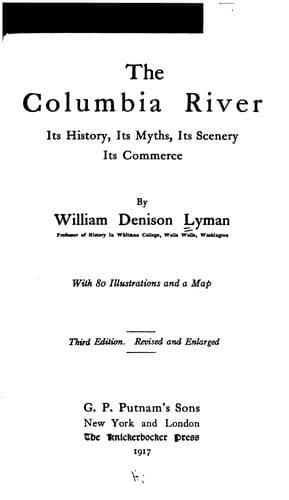
The Columbia River: Its History, Its Myths, Its Scenery, Its CommerceLyman, William Denison
History
The Columbia River: Its History, Its Myths, Its Scenery, Its Commerce
Lyman, William Denison
Columbia River; Columbia River -- Description and travel; Columbia River -- History
An interesting character lives on the shore of Lake Windermere in the
person of Baptiste Morigeau. He is a man of sixty-six, the son of a French
father and Indian mother. The father, Francis Morigeau, was born at Quebec
in 1797, and came to the upper Columbia region as a free trapper in 1820.
He trapped up and down the Columbia for many years, selling his catches to
the Hudson's Bay Company, usually at Fort Colville. Baptiste was born at
Windermere in 1842. Three years after that the father with his numerous
family went to Colville. He had a number of horses and cattle, a large
supply of valuable furs, ammunition, and traps. He located at Colville at
just the right time. For, having taken up a large body of the rich land in
that valley, he began raising hay and grain. His stock increased. He was
surrounded with every species of rude plenty, and just at the most
profitable time for him the gold discoveries began in 1854, followed the
next year by the great Indian war. The fat cattle, the horses, the grain,
hay, and vegetables of the Morigeaus were in great and immediate demand.
Money came in to them by the handful. Baptiste states that they took in
one hundred and fifty thousand dollars during the five years of Indian
wars and settlement. Their lives were often in peril, but with good
fortune, aided by their own connection with the natives, they escaped any
serious harm.
On one occasion Indians were about to plunder them of their valuables and
take possession of the barn where several of the family were thrashing
grain with flails, when the oldest son, Aleck, suddenly turned his flail
upon the marauders. So vigorously did he lay about him and so astonished
were the Indians at the novel assault that they gave way and retreated.
Morigeau told us the interesting fact that there were practically no
Indians living in the Windermere district until about a century ago. At
that time some branches of the Shuswaps and of the Kootenais came in.
Their relations were usually very amicable, but between the Shuswaps and
the Okanogans was deadly and long-continued enmity. This was ended in a
curious and interesting manner by the following event. The Shuswaps had
captured the only daughter of the Okanogan chief. She was led with other
captives into the Shuswap camp. The boasting warriors were gloating over
the poor victim, and the squaws were discussing the greatest possible
indignities and tortures for her, when an aged, white-haired chief got the
attention of the crowd. He declared that his heart had been opened, and
that he now saw that torture and death ought to end. He proposed that
instead of shame and torture they should confer honour on the chieftain's
child. He said: "I can hear the old chief and his squaw weeping all the
night for their lost daughter." He then proposed that they adorn the
captive with flowers, put her in a procession, with all the chiefs loaded
with presents, and restore her to her father.
Public-domain text, read in full here on John Shaqi.
Reviews
Reviews
No reviews yet
Be the first to share your thoughts on this work.
Elsewhere in the archive
Join the Discussion
Join the discussion
Sign in to leave a comment or review.
Sign InorCreate an account