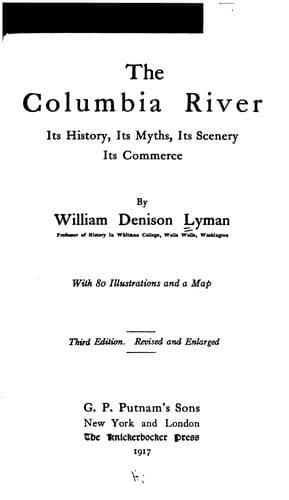
The Columbia River: Its History, Its Myths, Its Scenery, Its CommerceLyman, William Denison
History
The Columbia River: Its History, Its Myths, Its Scenery, Its Commerce
Lyman, William Denison
Columbia River; Columbia River -- Description and travel; Columbia River -- History
The girl meanwhile, who did not understand a word of the language, was
awaiting torture or death. What was her astonishment to find herself
decorated with honour, and sent with the gift-laden chiefs toward her
father's camp. On the next day the mourning chief of the Okanogans and his
wife, looking from their desolate lodge, saw a large procession
approaching, and they said: "They are coming to demand a ransom."
[Illustration: Bonnington Falls in Kootenai River, near Nelson. Photo by
Allan Lean.]
As the procession drew nearer, one of their men said that it looked like a
woman adorned with flowers in the midst of the men with presents of robes
and necklaces. Then they cried out: "It is our child, and she is restored
to us." So they met the procession with rejoicing and heard the speech of
the old Shuswap chief. And after that there was peace between the Shuswaps
and the Okanogans.
Having returned from Lake Windermere to Golden by small boat,--one of the
most charming of all water trips,--we are prepared to make a new start
down the River.
The River from Golden holds a general north-westerly course to its highest
northern point in latitude 52 degrees. There having received its northmost
tributary, Canoe River, a furious mountain stream, it makes a grand wheel
southward, forming what is known as the Big Bend. This section of the
River was navigated by the bateaux of the trappers and the canoes of the
Indians. There are, however, several bad rapids, of which Surprise Rapids,
Kimbasket Rapids, and Death Rapids, are the worst. These cannot be passed
by steamboats. The _voyageurs_ seem to have run them sometimes, though
they ordinarily made portages. A Golden steamboat captain assures us that
none but fools ever ran Death Rapids,--and they were mostly drowned.
The Canadian Pacific Railroad follows the Columbia from Golden to
Beavermouth, then turns up the Beaver to cross the Selkirk Mountains. The
Beaver is a magnificent mountain stream, and from the railroad, high on
the mountain side, the traveller can at many points look down hundreds of
feet upon the river. Though the Selkirks are not quite so high as the main
chain of the Rockies, they are even grander. The snowfall is materially
greater in the Selkirks, and the glaciers are vast in extent. It is said
that the snowfall at Glacier averages thirty-five feet during the winter,
and that it lies from four to eight feet deep from October to April. There
are thirty immense snowsheds on this section of the railroad.
Public-domain text, read in full here on John Shaqi.
Reviews
Reviews
No reviews yet
Be the first to share your thoughts on this work.
Elsewhere in the archive
Join the Discussion
Join the discussion
Sign in to leave a comment or review.
Sign InorCreate an account