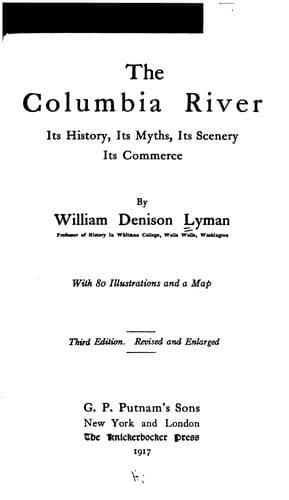
The Columbia River: Its History, Its Myths, Its Scenery, Its CommerceLyman, William Denison
History
The Columbia River: Its History, Its Myths, Its Scenery, Its Commerce
Lyman, William Denison
Columbia River; Columbia River -- Description and travel; Columbia River -- History
The traveller learns from the captain, if he can persuade that busy
personage to indulge in conversation, that the Arrow Lakes derived their
name from the fact that in early times great bundles of arrows could be
seen stuck in the clay banks or in the crevices of the rocks at the head
of the upper lake. The upper Arrow Lake has mountain banks rising
thousands of feet to the zone of eternal snow. The shores are usually
precipitous, though it is not uncommon to see smooth slopes furnishing
timbered margins to enchanting little bays. At various places along the
shores we see the beginnings of fruit and dairy ranches. It is only within
four or five years that anything has been done here in the way of
cultivation. The results thus far attained prove the wonderful
adaptability of soil and climate to choice fruits. And the
flowers,--Heaven bless them!--the sweetest and biggest and brightest of
roses, pinks, sweet peas, larkspurs,--every kind that grows, are seen in
profusion at almost every point where there has been any cultivation. By a
little conversation with people at the landings we learn that the
new-fledged ranches are very profitable. One tells us that he has made a
net profit of two dollars and twenty-five cents per crate on his
strawberries, or five hundred dollars an acre.
[Illustration: Bridal Veil Falls on Columbia River. Photo. by E. H.
Moorehouse.]
Perhaps the most attractive place on the Arrow Lakes is the point where
the upper lake narrows into the stretch of fifteen miles of river joining
the two lakes. The mountains on either hand, in great billows of forest
green and blue, rise ever upward till they break against the eternal
frost. The shores are clothed in dense forests, and on either hand bold
promontories enclose sheltered bays, the very beau ideals of camping
places.
We find the lower Arrow Lake of a gentler type of scenery than the upper.
The mountains no longer bear snow-peaks and glaciers on their crests, and
there are no longer to be seen the stupendous rocky walls which in places
enclose the upper lake. But as a compensation for the loss of this
pre-eminent grandeur, the lower lake possesses a charm of colouring, both
of water and shore, a richness of mountain outline and tints, and a
certain serenity which may well make it an equal of its grander companion.
At the lower end of the Arrow Lakes the steamer stops and transfers her
freight and passengers to the trains running from Robson to Nelson. This
is necessitated by the fact that the Kootenai River, which enters the
Columbia just below Robson, has a descent from Nelson of over two hundred
feet. The railroad follows the Kootenai, which almost rivals the Columbia
in magnitude. We pass the Bonnington Falls, the noblest waterfall on the
entire system of Columbia's tributaries, with the exception of the Great
Shoshone of the Snake.
Public-domain text, read in full here on John Shaqi.
Reviews
Reviews
No reviews yet
Be the first to share your thoughts on this work.
Elsewhere in the archive
Join the Discussion
Join the discussion
Sign in to leave a comment or review.
Sign InorCreate an account