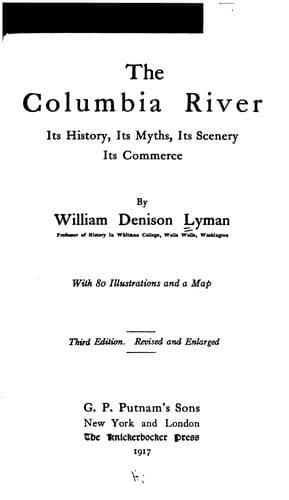
The Columbia River: Its History, Its Myths, Its Scenery, Its CommerceLyman, William Denison
History
The Columbia River: Its History, Its Myths, Its Scenery, Its Commerce
Lyman, William Denison
Columbia River; Columbia River -- Description and travel; Columbia River -- History
Reaching Nelson, the metropolis of this entire lake country, we find a
bustling, active, well-built little city of seven thousand people. The
leading industries centring at Nelson are mining and lumbering. It has
been discovered very recently, however, that the soil and air and climate
are peculiarly adapted to choice berries and fruits. The shores of the
river and lake at this point are rugged and rocky, at first thought ill
adapted to horticulture. But it is well known that rough locations produce
choicer fruit. Between the boulders or nestling against the hillsides, the
peach and apple take on an added blush, absorb a more delicate nectar,
exhale a more exquisite perfume. We are told that during the season of
1908 there were twenty thousand crates of berries, mainly strawberries,
shipped from Nelson, at a price of two to three dollars per crate.
In every direction from Nelson is mineral wealth of untold quantity.
Almost every mineral known, gold, silver, copper, zinc, lead, to say
nothing of every kind of fine building stone, including marble, besides
coal and iron, is found east, west, north, and south of Nelson. The town
itself was founded by reason of the Silver King mine, which can be seen
high up on the mountain side south of the place. The output of these mines
has been immense. In spite of the comparatively hard times, the output of
the three districts of the Kootenai, Rossland, and Boundary, was estimated
at $21,025,500 in 1907. One interesting fact connected with the mining
industry in the lake country is that at Nelson is located an electric zinc
smelter, the only one of the kind in the world. Zinc is found in
association with gold, silver, and copper, and, though valuable, is quite
an impediment to the mining of the gold and silver. This unique smelter
works by what is called the Snyder process, an electrical system, which,
if it accomplishes all that is hoped for, will open every mine on the
Kootenai.
[Illustration: Shoshone Falls, in Snake River, 212 Feet High. Photo. by W.
D. Lyman.]
From Nelson we find the way open by fine steamers to all parts of the
Kootenai. This largest of all the lakes of the Columbia system, containing
141,120 acres of surface, bears a general resemblance to the Arrow Lakes,
clear, deep, cold, with lofty mountains on either side and vast stretches
of purple forests crowding to the very margin of the water. This lake
consists of three arms, northern, southern, and western. The Kootenai
River enters by the southern and leaves by the western.
Public-domain text, read in full here on John Shaqi.
Reviews
Reviews
No reviews yet
Be the first to share your thoughts on this work.
Elsewhere in the archive
Join the Discussion
Join the discussion
Sign in to leave a comment or review.
Sign InorCreate an account