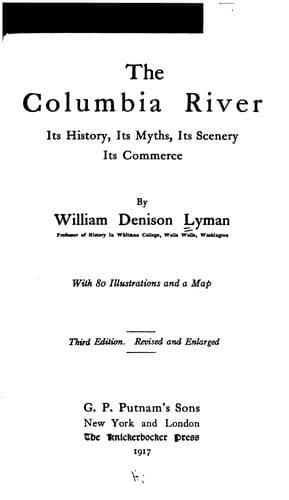
The Columbia River: Its History, Its Myths, Its Scenery, Its CommerceLyman, William Denison
History
The Columbia River: Its History, Its Myths, Its Scenery, Its Commerce
Lyman, William Denison
Columbia River; Columbia River -- Description and travel; Columbia River -- History
The northern part of the Kootenai region, especially around Kaslo,
possesses vast mineral wealth. A railroad proceeds from Kaslo to Sandon in
the heart of the mountains, and to Slocan Lake and thence to Nakusp on
the upper Arrow Lake. The scenery of Slocan Lake is even more wild and
rugged than that of the Kootenai. Both abound in fine trout. We saw a lake
trout at Nelson of a weight of twenty-two pounds. Ducks and geese and swan
are common on the water, limitless grouse and pheasants are found in the
woods, while deer, elk, and bear are common in the wild maze of mountains
and canyons;--a sportsman's paradise.
Tourists taking the route eastward go from Nelson on the elegant steamer
_Kuskanook_ to Kootenai Landing and there take up again the railway route
by the Crow's Nest. Such as desire to go to Spokane can leave the line at
Curzon and go southward to a connection with the Spokane International.
There is also a rail connection more directly between Nelson and Spokane
by the Spokane and Northern. This pursues more nearly the course of the
Columbia River, of which the traveller obtains delightful glimpses at
intervals. But for ourselves, we would rather go by rowboat from Robson
down the River over the historical route of the old _voyageurs_. No rail
route compares with the water.
The River is a superb water-way from Robson, British Columbia, to Kettle
Falls, Washington, about ninety miles. In fact, the section of the River
from Death Rapids above Revelstoke to Kettle Falls, including the Arrow
Lakes, is the longest unbroken stretch of deep, still water on the entire
River, being about three hundred miles.
Kettle Falls, too, is a historic spot. For here was Fort Colville of the
Americans and also the old Hudson's Bay post. Here was the greatest
centring of the fur-trade on the upper River. Here were the strongest of
all the Catholic missions, and here were the most fertile fields and the
earliest cultivated of any on the upper River. Here is the Colville Indian
Reservation, and here for many years the wily and untamable old savage
Moses herded his bands of "cuitans," watched the incoming whites with
jealous eye, and, as opportunity offered, made way with such wandering
prospectors or stockmen as he could find off their guard in rocky glen or
forest depth. (And none ever knew what became of them.) Here
Hallakallakeen (Eagle Wing) the great Nez Perce chief, commonly known as
Joseph, who waged the Wallowa War of 1877 to its bitter conclusion,
carried on the sad remnant of his days, and not far distant on the wild
Nespilem, he held his summer camp. In all directions around Colville and
Kettle Falls, up the Sans Poil and Kettle rivers, are opening mines and
farms, one of the most promising sections of all the promising State of
Washington.
[Illustration: Lake Pend Oreille, Idaho. Photo by T. W. Tolman.]
[Illustration: Lake Coeur d'Alene, Idaho. Photo. by T. W. Tolman.]
Public-domain text, read in full here on John Shaqi.
Reviews
Reviews
No reviews yet
Be the first to share your thoughts on this work.
Elsewhere in the archive
Join the Discussion
Join the discussion
Sign in to leave a comment or review.
Sign InorCreate an account