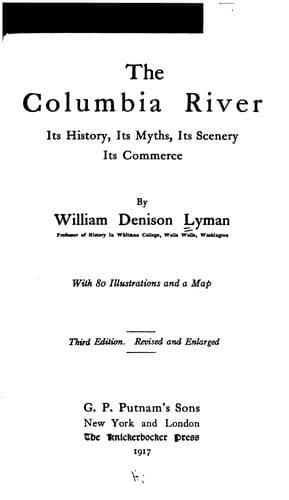
The Columbia River: Its History, Its Myths, Its Scenery, Its CommerceLyman, William Denison
History
The Columbia River: Its History, Its Myths, Its Scenery, Its Commerce
Lyman, William Denison
Columbia River; Columbia River -- Description and travel; Columbia River -- History
We had thought that the Columbia was clear, but we did not then know what
clear water really was. When we reach the mouth of Chelan River we know.
We see a streak of blue cutting right across the impetuous downflow of the
River. As we push our way into it we discover that it is so clear as to
make little more obstruction to the view of rocks and fish below than does
the air itself. This transparent torrent is the outlet of the lake. It is
only four miles long and descends three hundred and eighty feet in that
distance. It furnishes one hundred and twenty-five thousand horse-power at
low water. The canyon, riven and tortured, through which it descends, is a
fitting approach to the lake, unique Chelan. For having traversed the four
miles, we find the lake outstretched before us.
At this first view the lake has that look of a serene obliviousness to the
flight of passing centuries, that impressure of eternity, that belongs to
all great works of God or man. But majestic as is the view at the lower
end of the lake, we are not content to remain there. "_Neskika Klatawa
sahale_," cry we with a single voice, which being interpreted is, "Let us
go up higher," the motto, by the way, of our Mazama (Mountain-Climbers')
Club of the Pacific North-west. In skiffs, well-laden with provisions and
ammunition, we set forth on our sixty-mile pull toward "where the spectral
glaciers shone."
Delightful, delightful, almost ecstatic in truth, this rocking on the
glassy swell; this bed of romantic spruce and pine boughs on the beach;
this star-lit sky which is our only roof; this murmur of cascades falling
from the bluffs; this trolling for five-pound trout; this disembarking on
some rocky point and climbing a granite pinnacle from which a perfect maze
of mountains, streams, and forests, lies extended below; this experience
of the deadly attack of "buck-ague" which paralyses our arms as some goat
or deer dashes by; and then the inexpressible delight with which we,
"stepping down by zigzag paths and juts of pointed rock, came on the
shining levels of the lake." We do not wish to hurry our oars. We must
take time to look into the heavenly blue of the waters through the
foam-streaks left by our advancing prows. We must suspend the oar-dip
entirely at times while we gaze dizzied, with strained necks, up, up,
thousands of feet, toward "Death and Morning on the Silverhorns." We must
study shore and water as we pass slowly by, finding therein ample
confirmation of the theory of glacial origin.
Public-domain text, read in full here on John Shaqi.
Reviews
Reviews
No reviews yet
Be the first to share your thoughts on this work.
Elsewhere in the archive
Join the Discussion
Join the discussion
Sign in to leave a comment or review.
Sign InorCreate an account