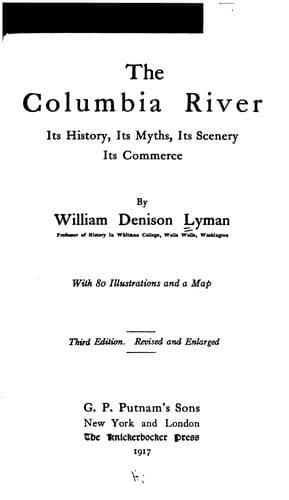
The Columbia River: Its History, Its Myths, Its Scenery, Its CommerceLyman, William Denison
History
The Columbia River: Its History, Its Myths, Its Scenery, Its Commerce
Lyman, William Denison
Columbia River; Columbia River -- Description and travel; Columbia River -- History
A hundred and forty miles from Spokane the great wheat plateau is broken
by the profound abyss of Snake River. Dark, turbid, sullen, not so
beautiful as the northern branches flowing out of the lakes, this largest
of all the tributaries of the River goes on its swift and treacherous
course to the union with the Columbia. Snake River is famous for its
orchards. Almota, Penewawa, Alpowa, Kelly's Bar, Clarkston, Asotin, are
the most prominent among many points where the cherries, peaches,
nectarines, apricots, berries, grapes, go out by the carload and
steamerload, earlier than anywhere else except on the banks of the
Columbia itself, to all parts of the West and even at times to Chicago and
New York. The region of these enormously productive fruit ranches is a
narrow ribbon of fertile land at the bottom of a canyon fifteen hundred
feet deep. Hot? Yes, hot! They say the mercury sometimes boils out of the
top of the thermometer. But heat and water and good soil make the rich
juice and bright cheeks of the peach and nectarine. Hundreds of miles up
Snake River in the wide expanses of Southern Idaho the waters are being
diverted for some of the largest irrigation enterprises on earth. There
the Twin Falls canal, one hundred feet wide and deep enough for a
steamboat, conveys the water to two hundred and eighty thousand acres of
land. The Minidoka canal covers almost as much. That part of the Snake
River Valley, three hundred miles long by fifty miles wide, will ere long
count its inhabitants by the million.
[Illustration: Inland Empire System's Power Plant, near Spokane, 20,000
Horse-Power. Photo. by T. W. Tolman.]
[Illustration: Lower Spokane Falls. Photo. by T. W. Tolman.]
No one could consider that he had really seen Snake River unless he had
visited the Great Shoshone Falls, or "Pahchulaka." This sublime
manifestation of nature's power is about forty miles from the town of
Shoshone on the Oregon Short Line. The total descent is nearly three
hundred feet, of which eighty consists of cataracts and chutes broken by
rocky islands, while the entire stream unites in the one final plunge of
two hundred and twelve feet. It is ten hundred and fifty feet wide, and
the walls of basaltic rock rise perpendicularly a thousand feet. Niagara
is the only waterfall on the American continent that can be compared with
Shoshone. Niagara is much wider but not so high. Its banks are tame,
while those of Shoshone are wildly sublime.
Public-domain text, read in full here on John Shaqi.
Reviews
Reviews
No reviews yet
Be the first to share your thoughts on this work.
Elsewhere in the archive
Join the Discussion
Join the discussion
Sign in to leave a comment or review.
Sign InorCreate an account