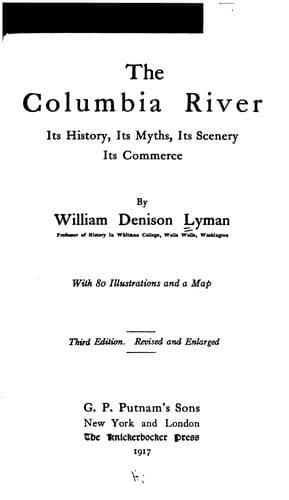
The Columbia River: Its History, Its Myths, Its Scenery, Its CommerceLyman, William Denison
History
The Columbia River: Its History, Its Myths, Its Scenery, Its Commerce
Lyman, William Denison
Columbia River; Columbia River -- Description and travel; Columbia River -- History
The spectres of history rise up at every stage of a journey along Snake
River. But we cannot pause. We pass on from the crossing of Snake River
and soon find ourselves approaching Walla Walla. This is the most historic
city of the Inland Empire and the oldest of the entire State of
Washington, with the exception of Vancouver. The pleasant-sounding name
signifies in the native tongue "Many Waters," though more literally, as
the author has been told by an old Cayuse Indian, "Place where four creeks
meet." The city of Walla Walla is thirty-two miles from the Columbia River
in the midst of a broad and fertile valley, through which dozens of clear
rivulets issuing from springs make their way through the birches and
cottonwoods. The warm climate, rich soil, and abundant water, with
multitudes of trees, give the "Garden City" an appearance of almost
tropical luxuriance. On all sides for many miles stretch the wheat-fields,
orchards, gardens, and alfalfa-fields. It is a land of plenty. It is
commonly said that Walla Walla has more automobiles, more bicycles, more
pianos, more flowers, and more pretty girls in proportion to population,
than any other town in the North-west.
The special historic interest of Walla Walla is found in the fact that it
was the location of the Whitman Mission and that the Whitman massacre took
place at the Mission Station, Waiilatpu, six miles from the city. That
spot is now marked with a marble crypt in which the bones of the martyrs
rest, and a plain but imposing granite shaft stands upon the crest of the
hill just above.
[Illustration: Canyon of the Stehekin, near Lake Chelan. Photo. by T. W.
Tolman.]
A more living monument to the missionary is found in Whitman College. This
institution, planned on the model of Amherst, Yale, and Williams, though
co-educational, was founded by Rev. Cushing Eells in 1859 as an academy.
It was not till 1883 that college work was undertaken. During that period
the self-denying missionary and his family supported the infant
institution by selling the products of their farm and devoting to it all
except what was absolutely necessary for their own support. During years
of slow, patient growth under very discouraging conditions, Whitman
College has made friends East and West, and within the last few years it
has become equipped with buildings and general facilities of high grade.
An effort is now in progress, apparently sure of fulfilment, to raise two
million dollars for buildings and general endowment. Walla Walla is
becoming peculiarly known as the educational centre and the home city of
the Inland Empire.
Public-domain text, read in full here on John Shaqi.
Reviews
Reviews
No reviews yet
Be the first to share your thoughts on this work.
Elsewhere in the archive
Join the Discussion
Join the discussion
Sign in to leave a comment or review.
Sign InorCreate an account