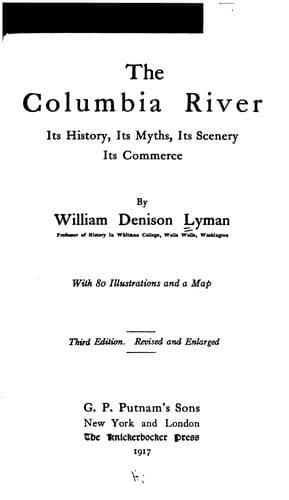
The Columbia River: Its History, Its Myths, Its Scenery, Its CommerceLyman, William Denison
History
The Columbia River: Its History, Its Myths, Its Scenery, Its Commerce
Lyman, William Denison
Columbia River; Columbia River -- Description and travel; Columbia River -- History
The productive capacity of these fat lands when softened with an
irrigating ditch and tickled with a hoe or cultivator is almost beyond
belief. In 1907 an orchardist in what is known as Parker Bottom in the
Yakima Valley raised on fifty-eight pear trees a crop of pears which was
sold for over three thousand dollars. This statement is well attested,
extraordinary as it sounds. It should be understood that such production
does not represent an average yield. The trees were of large size and of
the choicest variety, while conditions of production, price, and sale were
of the best. Yet similar records may be found in Wenatchee, Hood River,
Walla Walla, and others of the fine fruit-producing regions of the
Columbia Valley. A man in the Touchet Valley near Dayton, who had been for
twenty years a teacher at an average salary of a thousand a year, became
discontented with his narrow conditions, and by making credit arrangements
for a rich body of land has devoted himself for some years to the
development of an apple orchard. He has a hundred acres of trees, young
and of choice varieties, from which in the year 1907 he sold thirty-four
thousand boxes of fruit for approximately fifty thousand dollars.
But while we have been flying in imagination over the spacious valley of
the Yakima, our steamer has been speeding down the broad River, and we are
now within sight of a vast prairie stretching east and south, bounded on
the southern horizon by the azure wall, ridged with white, of the Blue
Mountains. To the east, this great plain melts into the sky. In fact it
extends to the Bitter Root Mountains, a distance of over two hundred
miles. On the west bank of the River we see a narrower plain bounded by a
steep treeless ridge. On either bank we see taking shape before us houses
and trees, while extended over the River, like threads of gossamer in the
distance, a bridge is outlined against the sky. We soon discover that we
are near Pasco on the east bank and Kennewick on the west bank of the
River. The bridge is that of the Northern Pacific and Spokane, Portland,
and Seattle Railroads. A mile below the bridge the Snake River joins its
greater brother.
This point is the very hub of the Inland Empire. Here the two great rivers
unite. Here steamboating on a vast scale will take place in the near
future. As soon as the locks are placed in the River at Celilo, a hundred
and thirty miles below, steamers can move freely to the ocean. Here three
transcontinental railroads pass, two down the River and one to Puget
Sound. Another is in process of construction to Puget Sound. Here a body
of the richest soil, on both sides of both rivers, embracing at least a
hundred and fifty thousand acres, waits only for water to bloom and yield
as Wenatchee and Yakima have already done. Here the long, hot summer
insures the earliest production of any part of the North-west, and in
early production the profit is found.
Public-domain text, read in full here on John Shaqi.
Reviews
Reviews
No reviews yet
Be the first to share your thoughts on this work.
Elsewhere in the archive
Join the Discussion
Join the discussion
Sign in to leave a comment or review.
Sign InorCreate an account