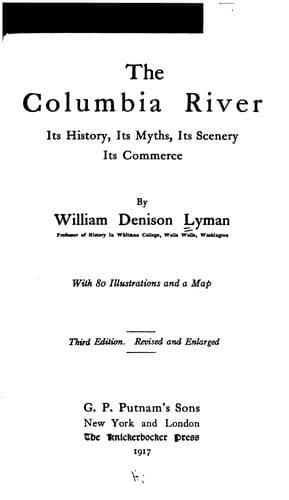
The Columbia River: Its History, Its Myths, Its Scenery, Its CommerceLyman, William Denison
History
The Columbia River: Its History, Its Myths, Its Scenery, Its Commerce
Lyman, William Denison
Columbia River; Columbia River -- Description and travel; Columbia River -- History
The beauty of irrigation on the Columbia is that it can be made to pump
itself. For by taking advantage of such a fall as that of Priest Rapids (a
half million horse-power at ordinary water), electric power can be
generated by which limitless water can be raised sufficiently to cover any
desired amount of land. Some have expressed the opinion that this process
would exhaust the River, but this is hardly possible. For the great
demands are in June and July when the River is at its flood. It has been
estimated that at low water the Columbia at Celilo discharges 125,000
cubic feet per second, and at extreme high water, 1,600,000 cubic feet per
second. Such a prodigious volume of water would be scarcely at all
affected by any possible withdrawals.
The River from the foot of Priest Rapids is regularly navigated by several
steamers connecting the new lands and towns with Pasco, the railroad
centre seventy miles below. This section of the River is deep and
tranquil, a superb watercourse. Below Hanford the River receives the
Yakima River, which is the important agent in the irrigation of the great
Yakima Valley. No one could say that he knew the Columbia River or the
State of Washington without a visit to that valley, the largest in the
State and the scene of the most extensive development in irrigated lands
anywhere in the North-west. Three thousand carloads of fruit and
vegetables were shipped from the Yakima in 1907. Buyers of Yakima fruits
come from all parts of the East, from England, and even from France.
Fortunes have been made in that fair land,--a fair land when supplied with
water, but an arid waste without it. The United States Government has
acquired control of most of the water system of the Yakima, and by means
of storage basins in the mountain lakes where the Yakima and its branches
rise, will be able to supply water for over a million acres of land.
[Illustration: On the Historic Walla Walla River. Photo. by W. D.
Chapman.]
Public-domain text, read in full here on John Shaqi.
Reviews
Reviews
No reviews yet
Be the first to share your thoughts on this work.
Elsewhere in the archive
Join the Discussion
Join the discussion
Sign in to leave a comment or review.
Sign InorCreate an account