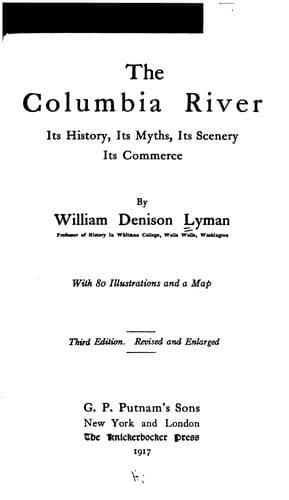
The Columbia River: Its History, Its Myths, Its Scenery, Its CommerceLyman, William Denison
History
The Columbia River: Its History, Its Myths, Its Scenery, Its Commerce
Lyman, William Denison
Columbia River; Columbia River -- Description and travel; Columbia River -- History
But Sahale, in order to show his appreciation of the care with which
Loowit had guarded the sacred fire, now determined to offer her any gift
she might desire as a reward. Accordingly, in response to his offer,
Loowit asked that she be transformed into a young and beautiful girl. This
was accordingly affected, and now, as might have been expected, all the
Indian chiefs fell deeply in love with the guardian of the tomanowas
bridge. Loowit paid little heed to any of them, until finally there came
two chiefs, one from the north called Klickitat and one from the south
called Wiyeast. Loowit was uncertain which of these two she most desired,
and as a result a bitter strife arose between the two. This waxed hotter
and hotter, until, with their respective warriors, they entered upon a
desperate war. The land was ravaged, all their new comforts were marred,
and misery and wretchedness ensued. Sahale repented that he had allowed
Loowit to bestow fire upon the Indians, and determined to undo all his
work in so far as he could. Accordingly he broke down the tomanowas
bridge, which dammed up the river with an impassable reef, and put to
death Loowit, Klickitat, and Wiyeast. But, inasmuch as they had been noble
and beautiful in life, he determined to give them a fitting commemoration
after death. Therefore he reared over them as monuments, the great snow
peaks; over Loowit, what we now call Mt. St. Helens; over Wiyeast, the
modern Mt. Hood; and, above Klickitat, the great dome which we now call
Mt. Adams.
Of the miscellaneous myths which pertain to the forces of nature, one of
the best is that accounting for the Chinook wind. All people who have
lived long in Oregon or Washington have a conception of that marvellous
warm wind which in January and February suddenly sends them almost summer
heat amid snow banks and ice-locked streams, and causes all nature to
rejoice as with a resurrection of spring time. Scarcely anything can be
imagined in nature more picturesque and dramatic than this Chinook wind.
The thermometer may be down nearly to zero, a foot of snow may rest like a
pall on the earth, or a deadly fog may wrap the earth, when suddenly, as
if by the breath of inspiration, the fog parts, the peaks of the mountains
may be seen half stripped of snow, and then, roaring and whistling, the
warm south wind comes like an army. The snow begins to drip like a pressed
sponge, the thermometer goes with a jump to sixty, and within two hours we
find ourselves in the climate of Southern California. No wonder the
Indians personified this wind. We personify it ourselves.
Public-domain text, read in full here on John Shaqi.
Reviews
Reviews
No reviews yet
Be the first to share your thoughts on this work.
Join the Discussion
Join the discussion
Sign in to leave a comment or review.
Sign InorCreate an account