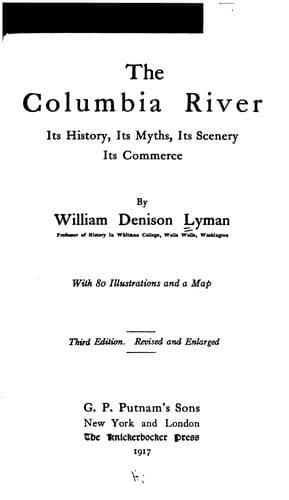
The Columbia River: Its History, Its Myths, Its Scenery, Its CommerceLyman, William Denison
History
The Columbia River: Its History, Its Myths, Its Scenery, Its Commerce
Lyman, William Denison
Columbia River; Columbia River -- Description and travel; Columbia River -- History
But now to contemplate the works of God and Nature rather than those of
man. We must, as already seen, by the necessities of space, ask our
readers to share with us only the masterpieces of this gallery of wonders.
Probably all visitors to the River would agree that the following scenes
most nearly express the spirit and character of the sublime whole: Castle
Rock, St. Peter's Dome, Oneonta Gorge, Multnomah Falls, Cape Horn, and
Rooster Rock. To these individual scenes we should add, as the very crown
of all, the view at the lower Cascades both up and down the great gorge.
With the majestic heights, scarred with the tempests and the earthquakes
of the ages, swathed in drifting clouds and oftentimes tipped with snow,
and the shimmering of the River, and the answering grandeur of sky and
forest,--this grouping of the whole is more inspiring than any one scene.
[Illustration: Castle Rock, Columbia River. (Copyright by Kiser Photograph
Co., 1902.)]
The first special object to fix our attention below the Cascades is Castle
Rock. It is an isolated cliff of basalt, nine hundred feet high, covering
about seventeen acres, its summit thinly clothed with stunted trees. It
stands right on the verge of the River, nearly perpendicular on all sides,
marvellous for symmetry from every point of view. At first sight one gets
no conception of its magnitude, for it is dwarfed by the stupendous
pinnacles, three thousand feet high, which compose the walls of the canyon.
It is said that some Eastern lady, seeing it from a steamer's deck,
exclaimed, "See that fine rock! I wish I had it in my back yard at home."
Being informed that she would have to find a pretty spacious back yard to
accommodate an ornament covering seventeen acres, she was too much
astonished to believe it. But to any one viewing it deliberately and from
every point of view, and especially landing, as we in our happy method of
travel can do, and going about its base, it becomes evident that Castle
Rock might be called a mountain in almost any other place. It was for a
long time regarded as an impossible thing to reach the summit. For some
years there was a standing offer of one thousand dollars for any one who
would place the Stars and Stripes on the summit. But no one took the dare.
At last in 1901, when the rivalry between two steamboat lines was keen,
Frank Smith of the Regulator Line, with George Purser and Charles Church,
accomplished the seemingly impossible, and, by ropes and staples and
fingers and teeth and toenails, scaled the almost perpendicular walls, and
unfurled the Regulator banner to the breeze where no flag ever flew
before, nor human foot ever trod. It was probably the most risky climb
ever taken in the North-west. A little later, by the aid of the experience
of this party, several others attained the summit. Among these were George
Maxwell, who set the Oregon Railway and Navigation flag as high as that of
the Regulator had gone, and two photographers, W. C. Staatz and George M.
Public-domain text, read in full here on John Shaqi.
Reviews
Reviews
No reviews yet
Be the first to share your thoughts on this work.
Elsewhere in the archive
Join the Discussion
Join the discussion
Sign in to leave a comment or review.
Sign InorCreate an account