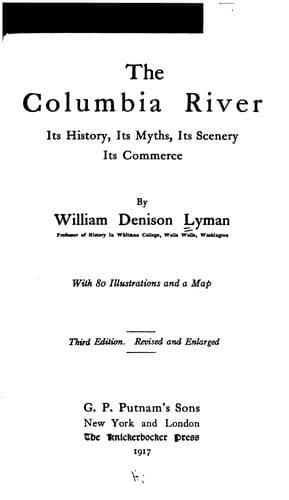
The Columbia River: Its History, Its Myths, Its Scenery, Its CommerceLyman, William Denison
History
The Columbia River: Its History, Its Myths, Its Scenery, Its Commerce
Lyman, William Denison
Columbia River; Columbia River -- Description and travel; Columbia River -- History
The total extent of the cataract at the Cascades is five miles and the
descent is about forty-five feet, of which half is at the upper end at the
point passed by the locks. We enter the locks in the wake of one of the
steamers, and in a few minutes find our craft emerging from the lower end
of the massive structure into the white water which bears us swiftly down
the remaining part of the Cascades. It looks dangerous to commit an open
boat to that sweeping current, but as a matter of fact the course of the
river is straight and deep, though swift, and it is entirely feasible for
any one of reasonable skill to manage a small boat in the passageway to
the tranquil expanses below.
[Illustration: Horseshoe Basin, near Lake Chelan, Wash. Photo. by T. W.
Tolman, Spokane.]
As we speed swiftly down the river, we note the little station of
Bonneville, named for the historic fur-trader whom the fascinating pages
of Irving have brought down to this era. A short distance below Bonneville
our eyes catch sight of a white sign-board bearing the words, "Petrified
Tree." Sure enough, there is the tree, and a marvellously fine specimen of
silicification it is, too. When the railroad was built along the river
bank at this point, the graders ran into a perfect forest of petrified
wood. The logs and limbs were piled up by the cord near Bonneville, but
the larger part has been taken in various directions for cabinets and
ornaments.
But a short time is needed to fly down the Cascades, and at their lower
end we reach what may be called the Lower River. For here a slight rise
and fall of tide betokens the presence of the ocean. No more rapids on the
River, but a tranquil, majestic flood, broadening like a sea toward its
final destination, a hundred and sixty miles away.
If we were to describe in detail all the marvels of beauty and grandeur
and physical interest which engage our attention at every stage of the
journey, our volume would end with this chapter, for there would be no
room for anything more. One class of objects of curious interest to almost
all travellers, though of no special charm to scientist or nature lover,
is the fish-wheels at the Cascades. These are very ingenious contrivances
set in the midst of a swift place in the stream and made to revolve by the
current. As they revolve, the huge vans dipping the water scoop up almost
incredible numbers of the salmon which have made the Columbia famous the
world over. A weir is built to turn the fish from the outside course into
the channel of the wheel, with the result that numbers are taken almost
beyond belief, sometimes as high as eight tons a day by a single wheel.
Another picturesque sight, both at the Celilo Falls and the Cascades, is
the Indian fishermen perched upon the rocks and with spear and dip-net
seeking to fill their larder with the noble salmon.
Public-domain text, read in full here on John Shaqi.
Reviews
Reviews
No reviews yet
Be the first to share your thoughts on this work.
Elsewhere in the archive
Join the Discussion
Join the discussion
Sign in to leave a comment or review.
Sign InorCreate an account