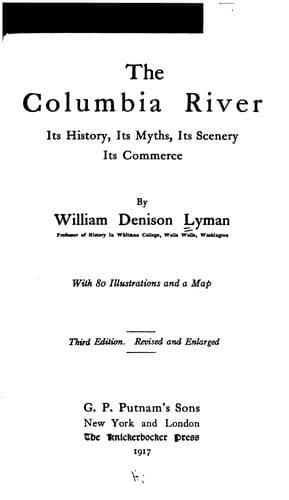
The Columbia River: Its History, Its Myths, Its Scenery, Its CommerceLyman, William Denison
History
The Columbia River: Its History, Its Myths, Its Scenery, Its Commerce
Lyman, William Denison
Columbia River; Columbia River -- Description and travel; Columbia River -- History
Around Mt. Adams is a region of caves. As one rides through the open
glades he may often hear the ground rumble beneath his horse's hoofs.
Mouths of Avernus yawn on every side. Some caverns have sunken in, leaving
serpentine ravines. One cave has been traced three miles without finding
the end. Some of these caves are partially filled with ice. There is one
in particular, fifteen miles south-west of the mountain, which is known as
Ice Cave. This is very small, not over four hundred feet long, but it is a
marvel of unique beauty. Its external appearance is that of a huge well,
at whose edge are bunches of nodding flowers, and from whose dark depths
issue sudden chilly gusts. Descending by means of a knotty young tree
which previous visitors have let down, we find ourselves on a floor of
ice. The glare of pitch-pine torches reveals a weird and beautiful scene.
A perfect forest of icicles of both the stalactite and stalagmite forms
fills the cave. They are from ten to fifteen feet in length and from one
to three in diameter. From some points of view they look like silvered
organ-pipes.
These caves have been formed in some cases by chambers of steam or bubbles
in the yet pasty rock which hardened enough to maintain their form upon
the condensation of the vapour. Others were doubtless produced by a tongue
of lava as it collected slag and hardened rock upon its moving edge,
rising up and curling over like a breaker on the sand. Only the "cave of
flint" instead of turning into a "retreating cloud" had enough solid
matter to sustain the arch and so became permanent. Others were no doubt
formed by pyroducts. A tongue of flowing lava hardens on the surface. The
interior remains fluid. It may continue running until the tongue is all
emptied, leaving a cavern. Such a cavern, whose upper end reaches the cold
air of the mountains, might be like a chimney, down which freezing air
would descend, turning into ice the water that trickled into the cave,
even at the lower end.
Public-domain text, read in full here on John Shaqi.
Reviews
Reviews
No reviews yet
Be the first to share your thoughts on this work.
Elsewhere in the archive
Join the Discussion
Join the discussion
Sign in to leave a comment or review.
Sign InorCreate an account