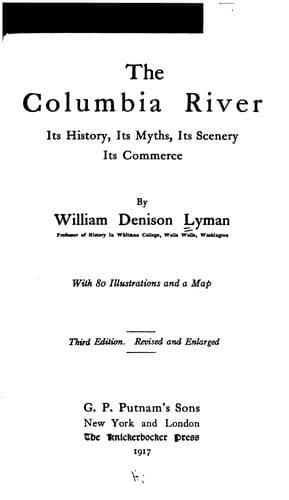
The Columbia River: Its History, Its Myths, Its Scenery, Its CommerceLyman, William Denison
History
The Columbia River: Its History, Its Myths, Its Scenery, Its Commerce
Lyman, William Denison
Columbia River; Columbia River -- Description and travel; Columbia River -- History
We woke again, chattering with cold, to find it perfectly calm. The
morning star was blazing over the spot where day was about to break. The
sky was absolutely clear, not a mote on its whole concavity. The wind had
swept and burnished it. The mountain towered above us cold and sharp as a
crystal. There was a still, solemn majesty about it in the keen air and
early light which struck us with a thrill of fear. The light just before
daybreak is far more exact than the scarlet splendour of morning or the
blinding blaze of noon. The world below us was a level sea of clouds. We
seemed to be on an island of snow and rock, or on a small planetoid
winging its own way in space. Yet beyond the puncturing top of a few of
the Simcoe peaks a wavering line that just touched the glowing eastern
sky, told of clear weather a hundred leagues up the basin of the
Columbia. Out of the ocean of cloud, the great peaks of Hood and St.
Helens rose, cold and white, like icebergs on an Arctic sea.
[Illustration: A Typical Mountain Meadow, Stehekin Valley, Wash. Photo. by
T. W. Tolman, Spokane.]
Coffee, ham, and hardtack, and then out on the ice and snow, just as the
first warm flush of morning is gilding the mighty mass above us. The snow,
hardened by the freezing morning, affords excellent footing, and in the
sharp, bracing air we feel capable of any effort. We gain the summit of a
bright red knob, one of the secondary volcanoes that girdle the mountain.
At its peak are purple stones piled up like an altar, as indeed it is,
though the incense from it is not of human kindling. The sun is not fairly
up, but from below the horizon it splits the hemisphere of the sky into a
hundred segments by its auroral flashes. And now we begin to climb a
volcanic ridge, rising like a huge stairway, with blocks of stone as large
as a piano. This is a tongue of lava, very recent, insomuch that it shows
no glacial markings, and yet enough soil has accumulated upon it to
support vegetation. It can be seen, a dull red river, three hundred yards
wide, extending far down the mountain side. How well the old Greek poet
described the process that must have taken place here: "AEtna, pillar of
heaven, nurse of snow, with fountains of fire; a river of fire, bearing
down rocks with a crashing sound to the deep sea."
The ridge becomes very steep, at an angle of probably thirty-five or forty
degrees, and we climb on all fours from one rock to another. At last we
draw ourselves up a huge wedge of phonolite and find ourselves at the
summit of the first peak. Six hundred yards beyond, muffled in white
silence, rises the great dome. It is probably five hundred feet higher
than the first peak. To reach it we climb a bare, steep ridge of shaly,
frost-shattered rock, in which we sink ankle deep, a difficult and even
painful task with the laboured breathing of twelve thousand feet altitude.
Public-domain text, read in full here on John Shaqi.
Reviews
Reviews
No reviews yet
Be the first to share your thoughts on this work.
Elsewhere in the archive
Join the Discussion
Join the discussion
Sign in to leave a comment or review.
Sign InorCreate an account