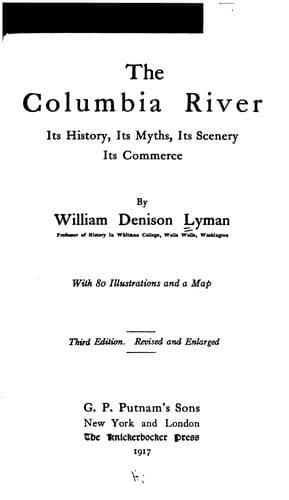
The Columbia River: Its History, Its Myths, Its Scenery, Its CommerceLyman, William Denison
History
The Columbia River: Its History, Its Myths, Its Scenery, Its Commerce
Lyman, William Denison
Columbia River; Columbia River -- Description and travel; Columbia River -- History
But patience conquers, and at about noon, seven hours and a half from the
time of starting, we stand on the very tip of the mountain. Ten minutes
panting in the cold wind and then we are ready to look around. Within the
circle of our vision is an area for an empire. Northward is a wilderness
of mountains. High above all, Mt. Rainier lifts his white crown unbroken
to the only majesty above him, the sky. The western horizon, more hazy
than the eastern, is punctuated by the smooth dome and steely glitter of
Mt. St. Helens. Far southward, across a wilderness of broken heights,
rises the sharp pinnacle of Mt. Hood, and far beyond that, its younger
brother, Jefferson. Still beyond, are the Alpine peaks of the Three
Sisters, nearly two hundred miles distant. Our vision sweeps a circle
whose diameter is probably five hundred miles. Far westward the white haze
betokens the presence of the sea. A deep blue line north-eastward, far
beyond the smooth dome of St. Helens, stands for Puget Sound. Numerous
lakes gleam in woody solitudes.
Having looked around, let us now look down. On the eastern side the
mountain breaks off in a monstrous chasm of probably four thousand feet,
most of it perpendicular. We crawl as we draw near it. Lying down in turn,
secured by ropes held behind, fearful as much of the mystic attraction of
the abyss as of the slippery snow, we peep over the awful verge. Take
your turn, gentle reader, if you would know what it seems to gaze down
almost a mile of nearly perpendicular distance. Points of rock jut out
from the pile and eye us darkly. That icy floor nearly a mile below us is
the Klickitat glacier. From beneath it a milk-white stream issues and
crawls off amid the rocky desolation. At the very edge of the great
precipice stands a cone of ice a hundred feet high. Green, blue, yellow,
red, and golden, the colours play with the circling sunbeams on its
slippery surface, until one is ready to believe that here is where
rainbows are made. We roll some rocks from a wind-swept point, and then
shudder to see them go. They are lost to the eye as their noise to the
ear, long before they cease to roll. Silence reigns. There is no echo. The
thin air makes the voice sound weak. Our loudest shouts are brief bubbles
of noise in the infinite space. A pistol shot is only a puff of powder.
Even the rocks we set off are swallowed up and we get no response but the
first reluctant clank as they grind the lip of the precipice. Nor do we
care much for boisterous sounds. We are impelled rather to silence and
worship.
[Illustration: High School, Walla Walla, Wash. Photo. by W. D. Chapman,
Walla Walla.]
Public-domain text, read in full here on John Shaqi.
Reviews
Reviews
No reviews yet
Be the first to share your thoughts on this work.
Elsewhere in the archive
Join the Discussion
Join the discussion
Sign in to leave a comment or review.
Sign InorCreate an account