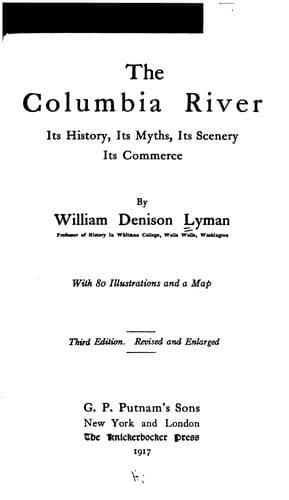
The Columbia River: Its History, Its Myths, Its Scenery, Its CommerceLyman, William Denison
History
The Columbia River: Its History, Its Myths, Its Scenery, Its Commerce
Lyman, William Denison
Columbia River; Columbia River -- Description and travel; Columbia River -- History
At Vancouver the newly-built "North Bank" Railroad (Spokane, Portland, and
Seattle) has constructed across the Columbia a bridge a mile and three
quarters in length, said to be the largest and costliest of its kind in
the world. This same railroad has also bridged the Willamette a few miles
west of Vancouver, thus effecting an entrance to Portland. This railroad
is one of the most interesting and remarkable undertakings of the age. It
is said that its cost from Spokane to Portland exceeded forty million
dollars. Vancouver expects much from this road, even anticipating that
much of the shipping hitherto centring in Portland will be diverted to the
larger river. However that may prove, it is plain that Vancouver has the
promise as well as the memory of great things.
Six miles west of Vancouver is one of those imposing scenes in which our
River so abounds. This is the junction of the Willamette with the
Columbia. This spot was noted by Broughton in 1792 as one of exceptional
beauty, and to it he attached the name Belle Vue Point. It is indeed a
combination of both historical and scenic interest. The Willamette steals
shyly and coquettishly through green islands to fall into the strong arms
of the stately Columbia. The western arm of the Willamette, commonly
called the "Slough," joins the Columbia eighteen miles below at the
picturesque little town of St. Helens. Between the Columbia and the Slough
lies Sauvie's Island, named from a Hudson's Bay man, and famous throughout
Hudson's Bay times as well as Indian times. The island was the seat of
power of the Multnomah tribe. The scene of the book known as the _Bridge
of the Gods_ by Frederick Balch is mainly upon this island, and in that
book will be found some glowing descriptions of this beauty spot. To the
Indians it was known as Wapatoo Island. In the ponds grew the plant called
the wapatoo, an onion-like root, very nutritious and palatable, and, with
salmon, constituting the chief food of the natives. Not only so, but the
Multnomah Indians used the wapatoo as a commercial stock, carrying on
regular trade with both the coast and the up-river tribes.
According to the early explorers there were great annual fairs on Wapatoo
Island, when Indians from ocean beach, from valley, from mountains, and
from River, both up and down, would gather to exchange products, to
gamble, race horses and boats, and have a general period of hilarity and
good fellowship.
Public-domain text, read in full here on John Shaqi.
Reviews
Reviews
No reviews yet
Be the first to share your thoughts on this work.
Elsewhere in the archive
Join the Discussion
Join the discussion
Sign in to leave a comment or review.
Sign InorCreate an account