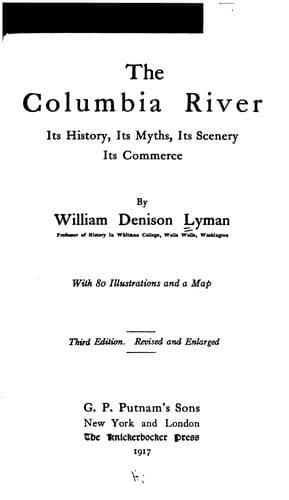
The Columbia River: Its History, Its Myths, Its Scenery, Its CommerceLyman, William Denison
History
The Columbia River: Its History, Its Myths, Its Scenery, Its Commerce
Lyman, William Denison
Columbia River; Columbia River -- Description and travel; Columbia River -- History
The gathering of the wapatoos developed upon the patient "klootchmen"
(women) of the tribe. They would go out in canoes to the shallow water
where the roots grew and then, stripping naked, would hang over the side
of the boat and dislodge the wapatoos with their toes from the soft mud.
Soon the surface would be covered with the floating roots. The squaws
would gather these into the canoes. Then they would move to another place
for another load. Sometimes they would spend almost the whole day in the
water. The wapatoo still grows in the ponds and lagoons of the island.
These ponds formerly abounded in ducks and geese and cranes and swans.
Even yet there is fine hunting. During the damp soft days of the Oregon
winter, the Nimrods of Portland betake themselves thither in great
numbers.
[Illustration: Lone Rock, Columbia River, about Fifty Miles East of
Portland. Photo. by E. H. Moorehouse, Portland.]
From the steamer, as we enter the mouth of the Willamette, or from the
greater elevation of the lighthouse, one may command one of the lordliest
views that even this land of lordly views affords. Five snow-peaks, Hood,
Rainier-Tacoma, St. Helens, Adams, and Jefferson, rise snow white from the
purple forests of the Cascade Range. Up the Columbia the great gorge
through which we have passed stands open to view, while down-river the
sinuous and hazy lines of low-lying shore betoken the nearer proximity of
the ocean. Up the Willamette, enchanting islands, with low watery shores,
occupy the foreground, while a short distance back from the western bank,
a chain of picturesque hills, heavily timbered, encloses the vista. On the
east side a low bench with bluffy promontories, crowned with the beautiful
smooth-barked madrona tree, rises from the green meadows.
If we could, from so fair an entrance, ascend the Willamette to its source
in the Cascade Mountains two hundred miles away, and if we could turn
into the Tualatin, the Yamhill, the Clackamas, the Molalla, the La
Creole, the Santiam, the Calapooia, affluents worthy of union with the
Willamette, and if we could tarry among the vales and meadows and
oak-crowned hills and distant Coast and Cascade ranges of mountains, all
across that superb valley, fifty miles wide by a hundred and fifty long,
as beautiful as Greece or Italy,--we would then all agree that the
Willamette deserves a volume by itself and that it is almost a crime to
introduce it so briefly here. Every old Oregonian, in thinking of the
Willamette, at once associates it with the apostrophe to it by S. L.
Simpson, the gifted and unfortunate poet of Oregon, whose genius deserved
a wider recognition than it ever received. The first stanza of his poem is
this:
Public-domain text, read in full here on John Shaqi.
Reviews
Reviews
No reviews yet
Be the first to share your thoughts on this work.
Elsewhere in the archive
Join the Discussion
Join the discussion
Sign in to leave a comment or review.
Sign InorCreate an account