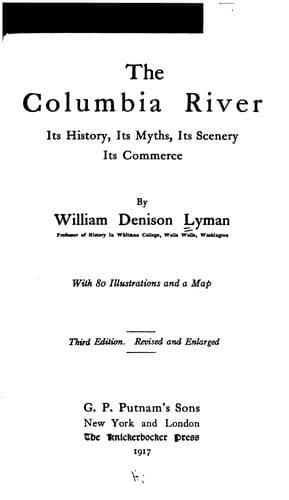
The Columbia River: Its History, Its Myths, Its Scenery, Its CommerceLyman, William Denison
History
The Columbia River: Its History, Its Myths, Its Scenery, Its Commerce
Lyman, William Denison
Columbia River; Columbia River -- Description and travel; Columbia River -- History
But to the thoughtful traveller it is of more interest to see the use made
of wealth than the wealth itself. Portland now contains about two hundred
thousand people, said to have more per capita wealth than any other city,
with two exceptions, in the United States. What are these people doing
with their accumulations? For answer the traveller visits the schools, the
public buildings, the churches, the stores, the places of amusement, the
homes, and he finds every evidence of taste, good judgment, refinement,
and artistic skill. The Portland Hotel, the _Oregonian_ building, the
Marquam Grand Theatre, the Marquam building, the Chamber of Commerce
building, the Corbett block, the Wells-Fargo building, the First
Congregational, Presbyterian, Catholic, and Baptist churches and Jewish
Synagogue, the Union Depot, the City Hall, the City Library,--these and
many other structures challenge the admiration of travellers from even the
best-built cities of the East. During the year 1907, building permits were
issued to an amount exceeding nine million dollars, of which nearly half
was expended for dwelling houses. Portland is indeed a city of homes, and
workingmen own their own houses to an unusual degree.
[Illustration: Portland in 1908. Mt. St. Helens, Sixty-five Miles
Distant.]
As the visitor traverses Portland's streets, he sees amply demonstrated
the propriety of the cognomen, the "Rose City." Almost every yard boasts
its roses, and on almost every porch the scarlet rambler or some other
climber casts its rich colouring. Soil and climate are said to produce an
ideal combination for the finest grades of roses, as well as of many other
species of flowers. The Portland Fair of 1905 was the means of beautifying
a section of the city near Macley Park. While most of the structures were
of a temporary nature, the unique and interesting Forestry building has
been left, and this is a rare attraction to the Eastern visitor. The two
tasteful and significant groups of statuary, _The Coming of the White Men_
and _Sacajawea_, still grace the spot where they were dedicated. Portland
contains many other attractive works of art at available points. Among
these is the Skidmore Fountain, on one of the most crowded thoroughfares
of the city, a real gem of art.
No visitor to Portland should fail to visit the City Hall and the valuable
and interesting historical collection of the Oregon Historical Society.
Mr. George H. Himes, the Secretary of the Society, has devoted years to
the gathering of this museum of pioneer relics. Some of them are
priceless. Here is the first printing press in Oregon, used for some years
by Rev. H. M. Spalding at the Nez Perce Mission. Here is Mrs. Whitman's
writing desk. Here is Captain Robert Gray's sea-chest. The ages of
discovery, of the fur-traders, of the missionaries, of the pioneers, are
all lived over again in the inspection of these relics.
Public-domain text, read in full here on John Shaqi.
Reviews
Reviews
No reviews yet
Be the first to share your thoughts on this work.
Elsewhere in the archive
Join the Discussion
Join the discussion
Sign in to leave a comment or review.
Sign InorCreate an account