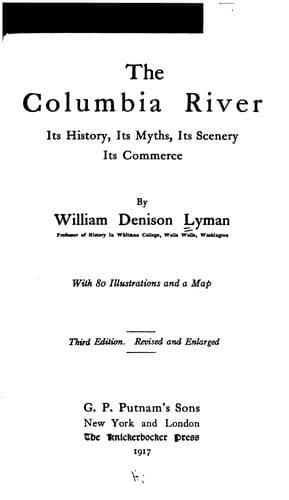
The Columbia River: Its History, Its Myths, Its Scenery, Its CommerceLyman, William Denison
History
The Columbia River: Its History, Its Myths, Its Scenery, Its Commerce
Lyman, William Denison
Columbia River; Columbia River -- Description and travel; Columbia River -- History
After passing the ingress of the Cowlitz, we find the River widening to
yet grander proportions. Islands become numerous. Among these islands not
a few desperate affrays and even tragedies have occurred among warring
fishermen, union against non-union. Lurking among these islands, too, are
numerous unlicensed vendors of spirits. In the uncertainty as to which of
the States may have jurisdiction at places, these illicit traffickers move
from island to island and cove to cove and one overhanging forest to
another, evading officers of both States and of Federal Government alike.
Sometime a novelist will be inspired with the poetry and humour and
tragedy and pathos of this fisher life on the lower River, with its
mingling of the life of law-breaker and desperado, and this section of our
River will blossom into literature and find a place with the moonshiners
of the South and the cowboys of the Rockies. All the material is ready.
The River waits only for its Owen Wister or Hamlin Garland or Jack London
to introduce it to the world of readers.
But the River moves and we must move with it. Many signs indicate to us
that we are approaching the ocean. If we are moving in a small boat, we
may pause to camp under some one of the thick-topped spruce trees whose
stiff spicules pierce our unwary hands like pins. If we should spend a
night we would find the water heaving and falling two, four, or five feet,
with the ocean tides. Broader and broader grows the River. Numerous salmon
canneries and seining stations appear. Passing a fishing village on the
north bank called Brookfield, we notice a very curious rock, Pillar Rock,
in the River a quarter of a mile from shore. It rises forty feet directly
out of the water. We are told by one versed in Indian lore that this is
the transformed body of a chief who tried to imitate the god Speelyei by
wading across the River. For his presumption he was turned into a rock.
Soon after passing Pillar Rock we see the curious spectacle of a house on
piles apparently right in the middle of the River. More curious still, we
see horses seemingly engaged in drawing a load through the very water
itself. The mystery is soon solved. The house is built on a sand-bar. It
is a seining station. The horses are pulling a seine from its moorings at
the point of the sand-bar to the point where its load may be discharged.
Lumber, salmon, and water,--this is the world in which we now live and
move and have our being.
[Illustration: Fish River Road, in Upper Columbia Region, B. C. Photo. by
Trueman, Victoria.]
Public-domain text, read in full here on John Shaqi.
Reviews
Reviews
No reviews yet
Be the first to share your thoughts on this work.
Elsewhere in the archive
Join the Discussion
Join the discussion
Sign in to leave a comment or review.
Sign InorCreate an account