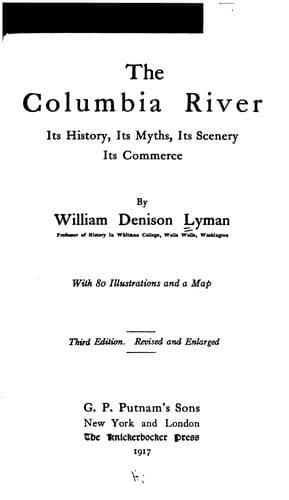
The Columbia River: Its History, Its Myths, Its Scenery, Its CommerceLyman, William Denison
History
The Columbia River: Its History, Its Myths, Its Scenery, Its Commerce
Lyman, William Denison
Columbia River; Columbia River -- Description and travel; Columbia River -- History
We next enter a broad expanse of the River, nine miles wide, on the north
side of which is a deep cove. There is the historic spot in which Robert
Gray on May 3, 1792, paused at his highest point to fill his water casks
and to float the Stars and Stripes over Oregon, claimed for the United
States of America. As we look westward, the headlands seem to part in
front of us, and between them sky and water join. The greatest ocean is
before us, though still twenty miles away. The River has reached the end
of his fourteen-hundred-mile journey. Soon we pass, on the Oregon side,
the bold promontory of Tongue Point, and Astoria, the second largest city
on the navigable waters of the Columbia, is before us.
To the history of this oldest American town west of the Rocky Mountains we
have already referred many times. Interesting in so many features of the
past, Astoria is full of problems and suggestions, commercial and
otherwise, for the present and the future. The city has grown slowly,
always wondering why Portland should have so outstripped her. She
certainly has such a location that it seems a crime not to utilise it for
a great city. The River is here five miles wide. Upon its ample flood all
the navies of the world might ride at anchor, sheltered from the sea by
the long low sand-ridge of Point Adams. The site of the city, though
somewhat rugged and broken, is entirely capable of reduction to a
convenient grade, and is singularly noble and commanding. From the plateau
three hundred feet high upon which the splendid waterworks are located, is
a view of imposing grandeur;--River in front, dense forest to rear, with
the blue saddle and pinnacled horn of Saddle Mountain,--Swallalochost in
Indian speech, with its thunder-bird of native myth,--and the ocean to the
west. We find Astoria to be a well-built city of about fifteen thousand
permanent inhabitants, with perhaps five or six thousand more during the
height of the fishing season. Almost every resource of industry offers
itself in this favoured region about the mouth of the River. Though the
country is densely timbered in its native state, the soil is such that
when cleared it is of the finest for dairy and vegetable purposes. The
mildness of the climate keeps the clover and grass green and the flowers
in bloom the long year through.
Public-domain text, read in full here on John Shaqi.
Reviews
Reviews
No reviews yet
Be the first to share your thoughts on this work.
Elsewhere in the archive
Join the Discussion
Join the discussion
Sign in to leave a comment or review.
Sign InorCreate an account