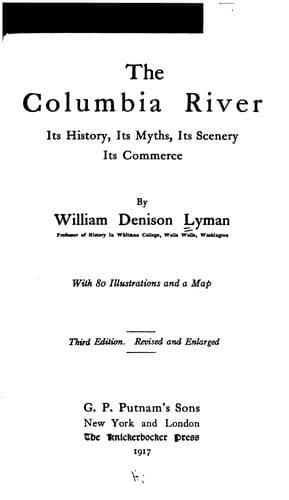
The Columbia River: Its History, Its Myths, Its Scenery, Its CommerceLyman, William Denison
History
The Columbia River: Its History, Its Myths, Its Scenery, Its Commerce
Lyman, William Denison
Columbia River; Columbia River -- Description and travel; Columbia River -- History
As might be expected the chief industries as yet developed are lumbering
and fishing. There are magnificent forests of fir, spruce, cedar, and
hemlock, in all directions, while in and around Astoria there are six
immense establishments for transforming the timber into merchantable
lumber. This lumber aggregates something like a hundred and twenty million
feet annually, and it goes to all the ports of the world. There is
occasionally floated to the bar and thence to San Francisco, a log-boom
chained in substantial fashion and containing several million feet of
logs. Such a great boom is one of the most curious sights of the
River-mouth. But transcending all else in importance at Astoria is the
business of canning and drying salmon. What silver is to the Coeur
d'Alene, what wheat is to Walla Walla, what apples are to Hood River, that
salmon are to Astoria. The people think, act, and reason in terms of
salmon. And well they may. He who has not seen Chinook salmon from the
Columbia River has not seen fish. Nay, he cannot even be said to have
really lived in the larger sense of the term. Take a genuine Chinook
salmon of fifty or sixty pounds, caught in June, fat, rich,
glistening,--but words are a mockery. Nothing but the actual experience
will convey the impression. The salmon output on the River has for some
years run from two hundred and fifty thousand to five hundred thousand
cases per year, twenty-four cans to the case. The amount dried and smoked
represents something like an equal amount. This is for the River from
Astoria to The Dalles. The great bulk of this, however, is put up at
Astoria or in its immediate vicinity. It is estimated that from thirty
million to forty million salmon are caught yearly on the Oregon side of
the lower River. This represents a value of four or five million dollars,
about half of this going to the fishermen and half to the cannerymen. Some
ten thousand men are engaged in fishing about the mouth of the River.
These men are largely Finns, Russians, Norsemen, Italians, Sicilians, and
Greeks. They have various co-operative associations and are independent of
the cannerymen, to whom they furnish the fish at some stipulated price,
usually five cents a pound.
[Illustration: Multnomah Falls, 840 Feet High, on South Side of Columbia
River about Sixty Miles above Portland. Photo. by E. H. Moorehouse,
Portland.]
Public-domain text, read in full here on John Shaqi.
Reviews
Reviews
No reviews yet
Be the first to share your thoughts on this work.
Elsewhere in the archive
Join the Discussion
Join the discussion
Sign in to leave a comment or review.
Sign InorCreate an account