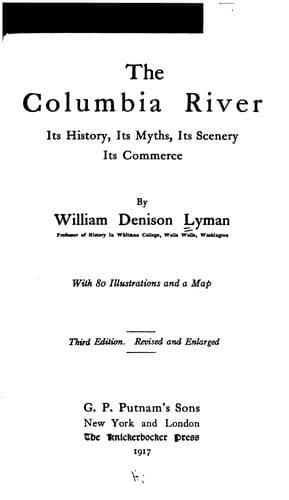
The Columbia River: Its History, Its Myths, Its Scenery, Its CommerceLyman, William Denison
History
The Columbia River: Its History, Its Myths, Its Scenery, Its Commerce
Lyman, William Denison
Columbia River; Columbia River -- Description and travel; Columbia River -- History
Since we are speaking of first steps across the wilderness we should not
forget that those of other nationalities than ours first crossed the
American continent. The honour of the pioneer expedition to the crest of
the Rocky Mountains belongs to the Frenchman, Verendrye. In 1773 he set
forth from Montreal for the Rocky Mountains, and made many important
explorations. His party is said to have reached the vicinity of the site
of Helena, but never saw the sunset side of the Great Divide.
We are told by the interesting French writer, La Page, that the first man
to proceed across the continent to the shores of the Pacific was a Yazoo
Indian, Montcachabe or Montcacht Ape by name. According to the story, his
two-year journey across the great wilderness through every species of
peril and hardship, savage beasts and forbidding mountains and deserts,
hostile Indians often barring his progress for many days, was one of the
most remarkable explorations ever made by man. This Yazoo Indian with the
long name was a veritable Columbus in the nature of his achievements. But
results for the world could hardly follow his enterprise.
The first traveller to lead a party of civilised men through the Shining,
or the Stony Mountains, finally known as Rocky Mountains, to the Pacific
Ocean, was Alexander Mackenzie, a canny Scotchman, leading a party of
Scotch and French Canadian explorers. In 1793 he reached the Pacific Coast
at the point of 52 degrees 24 minutes 48 seconds north latitude. His
inscription upon a rock with letters of vermilion and grease, were read
many years afterwards: "Alexander Mackenzie, from Canada by land, July 22,
1793."
But the explorations of Canadians were too far north to come within the
scope of the Pacific North-west of our day. We must therefore take up the
American expeditions which proceeded from the master mind of Jefferson.
The first of these was the expedition of Lewis and Clark. This expedition
did more to broaden the American mind and to fix our national destiny than
any similar event in our whole history.
As soon as Jefferson was inaugurated president, he had urged upon Congress
the fitting out of an expedition "to explore the Missouri River and such
principal streams of it as, by its course of communication with the waters
of the Pacific Ocean, whether the Columbia, Oregon, Colorado, or any other
river, may offer the most direct and practical water communication across
the continent, for the purposes of commerce."
Public-domain text, read in full here on John Shaqi.
Reviews
Reviews
No reviews yet
Be the first to share your thoughts on this work.
Elsewhere in the archive
Join the Discussion
Join the discussion
Sign in to leave a comment or review.
Sign InorCreate an account